Principles for Dealing with the Changing World Order: Why Nations Succeed and Fail
Introduction
- Everything goes around in a cycle. >100 year cycles with world powers, 100 year long term debt cycles, 8 year short term debt cycles, recessions etc.
- Prosperous times: depression/revolution times = 5:1
- People generally expect future to be slightly different from near term past
Ch 1: The Big Cycle in a Tiny Nutshell
- Major empires of study:
- Last 3 reserve currencies: Dutch, British, and American
- The other 6 significant empires in the past 500 years: Germany, France, Russia, India, Japan, China
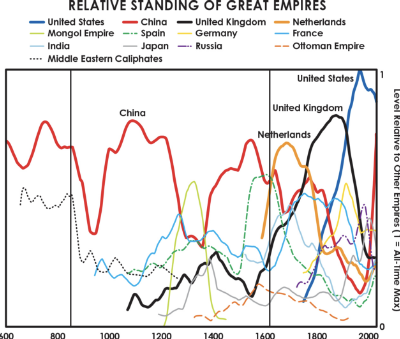
- Major Chinese empires since 600AD
- Last 3 reserve currencies: Dutch, British, and American
- Common thread in all empires- the struggle to make, take, and distribute wealth.
- People with the wealth then own the means of wealth production. They work with those with power to set and entrench rules.
- Then hard times hit them and they’re overextended and economic pain befalls everyone and a new world order takes shape
Understanding the Big Cycle
- 3 major cycles making the big cycle:
- Long term debt and capital markets cycle, internal order/disorder, and external order/disorder
Evolution, Cycles, and the Bumps Along the Way
- Human productivity is the most important causal force for increasing world wealth and living standards over time.
- Evolution/cycles always trend upwards- like a corkscrew facing up and right
- Industrial revolution took wealth creation away from landowners into hands of industrialists. Wealth and power now come from education, inventiveness, and capitalism. Gvt now works for them and not monarch’s anymore.
The Cycles Around the Uptrend
- Over time, winning formula is educated people being funded by capital markets, owning the means of production, and making profits. Over long run, capitalism creates wealth and opportunity gaps tho
- Wealth gaps lead to conflict and debt/economic collapse.
- Economic and market declines ~3 years +/-2 years. Depends on speed of printing money to fill debt holes.
- Periods of destruction set stage for future prosperity that eventually is overextended in debt bubbles with inequality which produce new stress tests for world order
Past Big Cycle Shifts in Wealth and Power
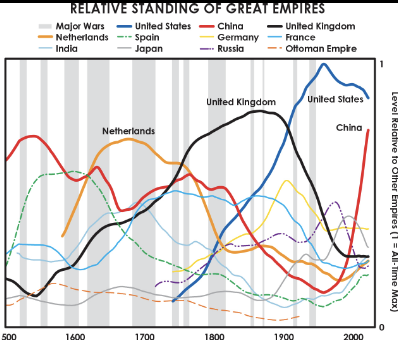
- Netherlands, Uk, and US are 3 most recent reserve currencies
Eight determinants of Wealth and Power
- Education
- Competitiveness
- Innovation and technology
- Economic output
- Share of world trade
- Military strength
- Financial center strength
- Reserve currency status
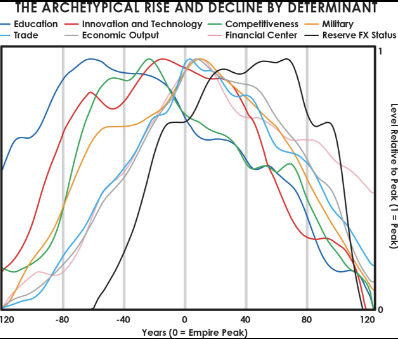
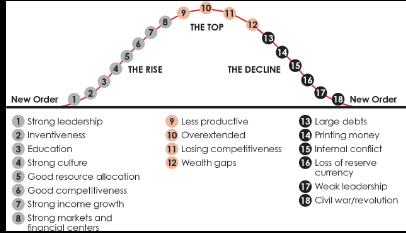
The Archetypical Big cycle
The Rise
- Effective leadership, good education, low inequality, good work ethic, infrastructure investments, developing capital markets, world reserve currency development
The Top
- Richer=less competitive
- compared to places with cheaper labor.
- Others copy too
- People work less hard and enjoy more leisure, more vulnerable to challenges
- Bet on good times continuing -> borrowings more
- Wealth gap grows and regulatory capture by the rich and powerful
- If living standards continue to grow, things don’t boil over yet
- Large debts from foreign lenders, short term liquidity, but long term currency is weakened bc of domestic over-consumption and spending on military conflict
The Decline
Internal Decline
- Comes from internal economic weakness together with internal fighting or costly external fighting, or all
- Large debts incentivize money printing. Devalues currency and increase inflation
- Creates internal conflict between rich and poor and political extremism from both sides
- Flight of wealth to avoid overtaxing. Shrinks productivity, further lower tax revenue
- Democracy most challenged here bc strong populist leader promises order. Sometimes civil war
External Decline
- International conflict possible if another power with big military
- Requires leading power to spend more on military as internal conditions worsen
- When debt and currency holders lose faith, they sell and cycle ends
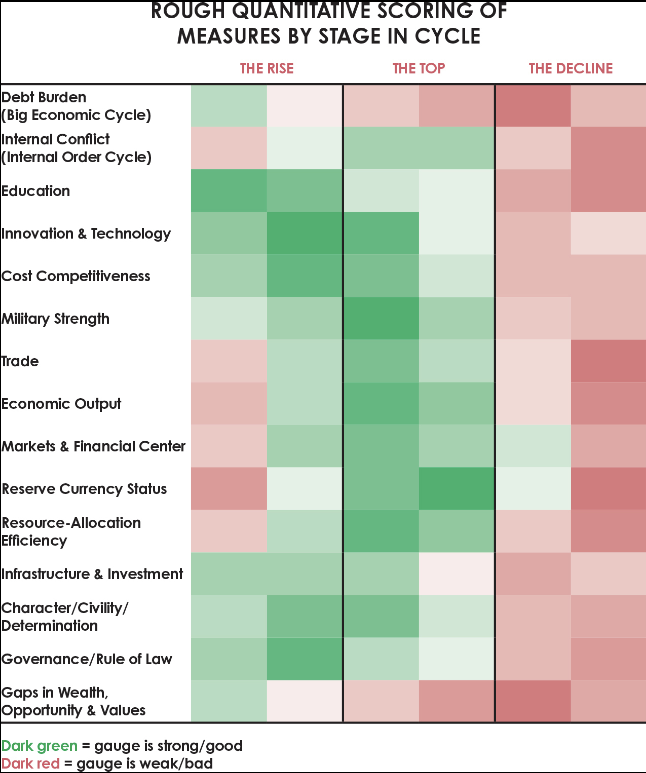
Ch 2: The Determinants
The 3, the 5, the 8, and the 18 Determinants
- 3 big cycles:
- Capital markets cycle
- Cycle of internal order and disorder. I.e. fighting over wealth and value gaps
- Cycle of external order and disorder.
- +2 more
- Pace of innovation
- Acts of nature
- 18 major determinants:
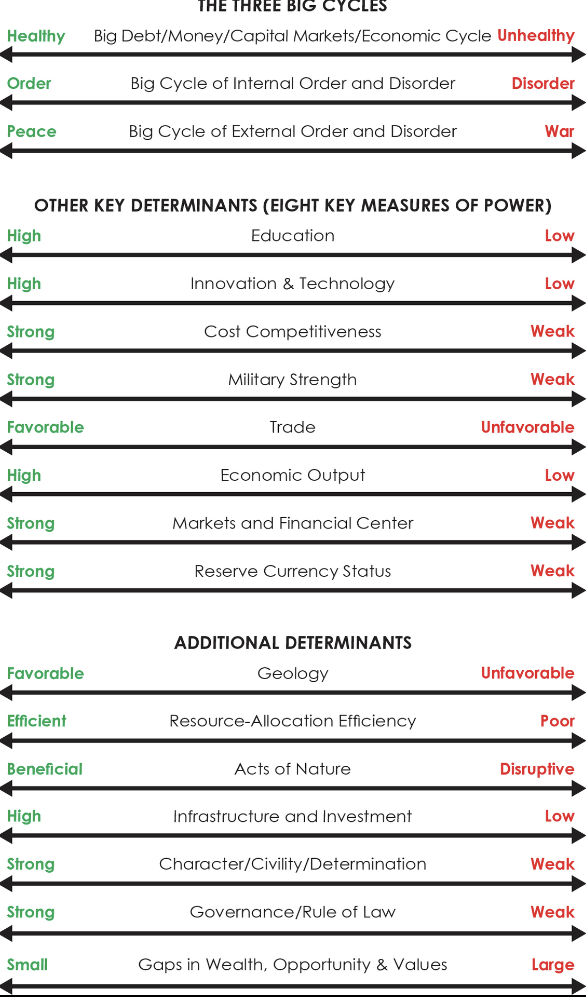
- These determinants aren’t all independent. Much interaction and blending
- Extra “soft” variables
Exploring the Determinants and Dynamics
Inherited Determinants
-
Geography
- Terrain, natural boundaries. Can determine nature of countries that start
-
Geology
- Natural resources. Reliance on one is bad
-
Acts of nature
- Stress test to systems. Larger effects than human led events
-
Genealogy
- More nurture than nature
Human Capital Determinants
- Culture, human nature things. Best form of capital because it can’t be drawn down
- All individuals earning more than they spend
-
Self-interest
- Can be individual, family, city, state, country, world
- Dominant level dictates internal order
-
Drive for wealth & power
- All consuming for top
- Wealth = buying power
- Making wealth = productivity. Investment instead of consumption
-
Capital markets
- That they exist and are efficient
-
Learning from experience
-
Multi-generational psychological cycle
- 3 generations. Same as long term debt cycle
- Strong human capital can extend this
- Stage 1: people and country are poor and act accordingly
- Can’t borrow, don’t waste money. Hard work&savings to get out
- Stage 2: people and country are rich, but still act poor
- Work hard, save, invest in real assets, invest in infrastructure & edu
- Low inflation, low debt to GDP
- Stage 3: people and country rich and act rich
- Reduced work hours. More enjoyment
- Still productivity gains
- USA from 1950-65, China now
- Disagree?
- Stage 4: people and country poorer, still act rich
- More debt, less saving, military spending
- Twin deficits
- Balance of payments and gvt deficits?
- Stage 5: people and country poor, act poor
- Bubble popped. Deleveraging
- Inflation, money printing. Decline
- 3 generations. Same as long term debt cycle
-
Favoring long term over short term
- Hard with politics
-
Inventiveness
- Important
-
Culture
- Worldview
-
Openness to global thinking
- Isolation leads to less tech
-
Leadership
- Adds some randomness
-
Wealth gaps
- Conflict
-
Values gaps
- Also conflict
-
Class struggles
- race, religion, gender, location, lifestyle, politics, etc.
- not big divisions when times are good, but it gets worse in times of bad economy. Revolution and unrest can ensue
-
Political L/R
- Swings with booms & busts. Economic crises start revolutions
-
Prisoners dilemma
- Avoid war by intermingling
- Didn’t work with Russia
- Avoid war by intermingling
-
Win win and lose lose relationships
- Cooperation within the existential red lines of the other. Sometimes impossible
-
Power balance governing peace/war
- usually two powers. One in power and the minority power makes alliances with the other minority powers to try and take on the big power
- After a big conflict, the winners then fight amongst themselves for power. Mostly internal
-
Military strength
- Bc no effective international judiciary exists. Sometimes we need to fight
Ch 3: The Big Cycle of Money, Credit, Debt, and Economic Activity
The Timeless and Universal Fundamentals of Money and Credit
- All entities (individuals, companies, countries, non-profits etc.) have common basic financial reality: income, expenses, profit, savings, debt, net worth, assets, liabilities etc.
- Debt cycle is inherently cyclical.
- One entities spending is another’s income; one’s debts are another’s asset.
- Self reinforcing downward debt and economic contraction results from one side failing.
- Debt eats equity
- Debt must be paid before equity owners. Assets will be sold to pay back debtors.
- Money supply not fixed. Central banks can create money and credit. Only ones that can.
- By printing money, central banks can feed debt to avoid crisis
- Becoming a reserve currency country sows the seeds of ceasing to be a reserve currency country. Makes borrowing very easy and money printing is inevitable bc politics
What Is Money?
- Medium of exchange and store of wealth
- Debt is a promise to deliver money
- An asset for lender (a bond)
- A liability to borrower
- when $ paid back, assets and liabilities are cancelled out and both have “shared profits” of productive lending
Money, Credit, and Wealth
- Money and credit can buy wealth, but wealth can’t be created with just money and credit. Productivity must increase.
- Because real and financial economies are different with different supply/demand curves
- Real: determined by demand of goods and services
- if demand increases faster than supply, prices inflate
- Financial: determined by demand for money and credit
- central banks can raise and lower supply of money to lower/raise real demand for goods and services
- “monetary inflation” happens when supply of money and credit increases relative to demand for it.
- Different than real inflation since this is pure currency demand/supply
- Real: determined by demand of goods and services
- Because real and financial economies are different with different supply/demand curves
- Typically, when central banks stimulate, the market decides where to allocate the capital.
- but in times of crisis, gvt can decide where to put capital (i.e. COVID)
- Price vs. value
- Value of a good constant, even though price of it increases from inflation
- what if it’s value raises relatively more than other goods?
- When money and credit are given out its stimulating, but when debt comes due, it is depressing. inherently cyclical.
- Value of a good constant, even though price of it increases from inflation
- Short-term debt cycles ~8 +/-3 yrs-ish
- Long-term debt cycle ~50-75 yrs. Current one started in 1944 @breton woods
- ends when central bank looses the ability to use money and credit creation to produce real economic growth.
- creating money and credit weakens currency, and when debt is too high and interest rates can’t be lowered monetary inflation happens
- The creation of money and credit here increases financial asset prices more and real economic activity.
- Incentivize holders of debt to buy other stores of wealth
- because you expect them to default?
- Is this a flee from treasury bonds?
- Incentivize holders of debt to buy other stores of wealth
- The creation of money and credit here increases financial asset prices more and real economic activity.
The Long-Term Debt Cycle
Stage 1: Hard Money
- Debt burdens wiped out previously by restructuring or inflated away
- No trust or credit required to trade. Can use hard asset like Gold to exchange bc it doesn’t require trust
Stage 2: Claims on Hard Money
- Creating credit is good for lenders and borrowers. “Banks” or similar institutions arise to hold money and create claims on it.
- Creation of a “linked currency system”. A separate currency exchangeable for hard money (gold/silver)
Stage 3: Increased Debt
- All benefit from increasing debt. Borrowers get buying power, lenders get interest. All borrow more.
- Quantity of claims increases relative to actual goods and services there are to buy. i.e. debt assets > real assets
- Two problems:
- income can’t service the debt
- Claims raise much faster than the available goods/services and conversion becomes impossible
- How does conversion become impossible?
Stage 4: Breaking Hard Money Link
- Investors in debt may realize they aren’t going to get adequate returns relative to other stores of wealth or goods/services.
- When many realize this, there is a run to sell.
- This raises interest rates, lowers yields
- When many realize this, there is a run to sell.
- If central bank, the decision is to print money or allow $ to flow out of the debt asset (which raises interest rates and economic problems)
- eventually, central bank prints money and debases currency.
- alternative is deflationary depression.
- balancing act between deflation/inflation for how much $ to print
- eventually, central bank prints money and debases currency.
- if ratio of claims on money(debt assets) » hard assets & goods/services, then hard money can’t meet claims
- paper money = claims on hard money; debt = claims on paper money
- as paper money grows relative to hard money (other hard assets included in hard money, right?), debt assets are riskier because the link between the hard money and paper money is more tenuous.
- paper money = claims on hard money; debt = claims on paper money
Stage 5: Fiat Money & Debasement of Money
- Getting off the gold standard - Like Nixon in 1971
- in ‘71, lots of debt from spending on military and social programs. Claims on gold became larger than gold reserves.
- Incentives point towards creating more money and debt assets relative to amount of goods and services being produced. 2 outcomes:
- biggest holders of debt want to be paid back and cause a “run” on the gvt banks
- devaluation of money by printing more to get out of the mess
- Printing money is done after rates hit ~0%. 2008, COVID, great depression
-
“There is nothing wrong with having an increase in money growth instead of an increase in credit/debt growth, if the money is put to productive use. The risk is that it will not be. If money is printed too aggressively, and not used productively, people will stop using it as a store hold of wealth and shift their wealth into other things. (real estate?)”
- Printing money and buying bonds holds down interest rates, which stimulate borrowing and buying.
- raises financial asset prices, but inefficient at allocating capital
- when printing doesn’t allocate capital correctly, central gvt can borrow from central bank (who prints it) and spend where they see fit.
- “debt monetization” - more politically palatable than raising taxes, because it affects everyone, not just the taxed.
- Is bad for owners of the debts. makes money and debt cheaper, lower returns.
- these owners of debt then take out cheap loans to put into better stores of wealth (gold, certain stocks etc.)
- “debt monetization” - more politically palatable than raising taxes, because it affects everyone, not just the taxed.
- “Reflation”
- can stimulate new credit/money expansion - good for stocks
- or devalues money to produce monetary inflation - good for gold, commodities, I bonds
- Early on in long-term debt cycle when debt is low, there’s room to stimulate by lowering interest rates/buying assets or printing money. Will ensure economic growth
- later on, when debt is high, inflation more likely than economic growth
- 4 levers for policy makers to bring down debt
- Austerity
- Deflationary
- Debt defaults and restructuring
- deflationary, painful to both borrower who looses asset and to creditor who loses wealth as debt is written down
- Transfers of money/credit to those who need it more (Taxing)
- part of the solution normally, politically challenging
- printing money and devaluing it
- politically expedient, make people feel richer (on paper)
- Austerity
Stage 6: Flight back into hard money
- overprinting of money makes people sell debt assets. (lowing price of bonds bc of lower chance of them getting paid)
- Makes people flee the currency and also debt denominated in the currency.
- What kinds of debt in the currency? gvt bonds? company bonds?
- They flee into gold, silver, stocks with real value, and other currencies/assets.
- alternative reserve currency not required for this capital flight. $ can find other assets.
- reason for real estate blow?
- alternative reserve currency not required for this capital flight. $ can find other assets.
- Holding debt early in debt cycle is rewarding (when less debt outstanding)
- Later on, when more debt is outstanding, it is riskier and closer to default (esp. when taking ~low interest rate into account)
- people feel safer the closer to the end of this blow up. BC so far removed from last debt cycle
- 50-70 year debt cycles.
Long-Term Debt Cycle Summary
- 3 types of money:
- Hard money (e.g. metal coins)
- restrictive. money can’t be created
- Paper money (e.g. claims on hard money)
- money can be created, but when ratio of claims on hard money to hard money increases too much, bank runs occur
- Fiat money (e.g. debased paper money)
- money and credit run freely until confidence in the currency fails
- when currency fails, gvt needs to build confidence again, so they switch back to hard money
- Hard money (e.g. metal coins)
- Big cycle lasts ~50-75 years, and between 2-4 cycles are possible with a reserve currency regime.
- big cycles don’t necessarily break the currency system. write downs of debt can save them.
Ch 3 discussion questions
- We saw real inflation and monetary inflation in the past 2 years. Supply chain is real, and FED printing is monetary (M1 money).
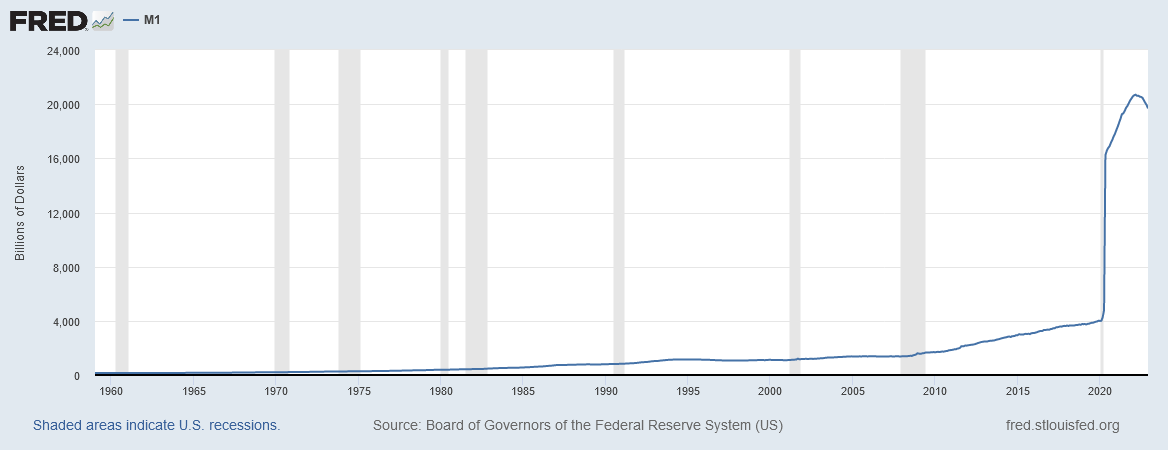
- Price vs. value:
- What if prices of something increase more W/R/T other goods. Does this mean value increases? Its all relative, right? increasing home value in austin did give you more buying power if you sold it after 40% inflation in price.
- End of long term debt cycle:
- holders of debt flee to other stores of wealth -> does this mean avoiding treasuries?
- Hard money:
- hard money also includes hard assets, correct? A good that can be directly exchanged for gold. i.e. a machine or real estate?
- this means that productivity increases constantly increase the amount of hard money?
- hard money also includes hard assets, correct? A good that can be directly exchanged for gold. i.e. a machine or real estate?
- Debt monetization:
-
At such times central banks have typically continued to print money and buy debt directly or indirectly while outlawing the flow of money into inflation-hedge assets
- How to outlaw flow of money somewhere?
- flee from fiat currency/debt pushes people to alt. assets. Is this the reason for real estate valuations?
-
Ch 4: The Changing Value of Money
- Currencies are wiped out usually by hyperinflation and/or lost wars with large war debts and replaced with new currencies
What do they devalue against?
- Their debt. Reduces debt burden for debtors because their debts are based on purchasing power of previous value of debt.
- when the creation of money sufficiently hurts the actual and prospective returns of productive cash and debt assets, money flows out of them and into inflation hedge assets like gold or commodities
- leads to a self reinforcing decline in value of money (inflation)
- central bank has a decision:
- raise real interest rates which will hurt economy or
- keep real interest rates low by printing and buying cash and debt assets to prop up economy
- most choose #2 and reinforce bad returns
- currency breakdown can happen when:
- amount of debt and money are too large to be turned into real value (I.e. goods and services) they are claims on
- interest rate level to keep debtors from bankruptcy is lower than the rate required for creditors to put money into that debt
- central bank interest rate changes (MP1) and QE (MP2) don’t work
In Relation To Gold
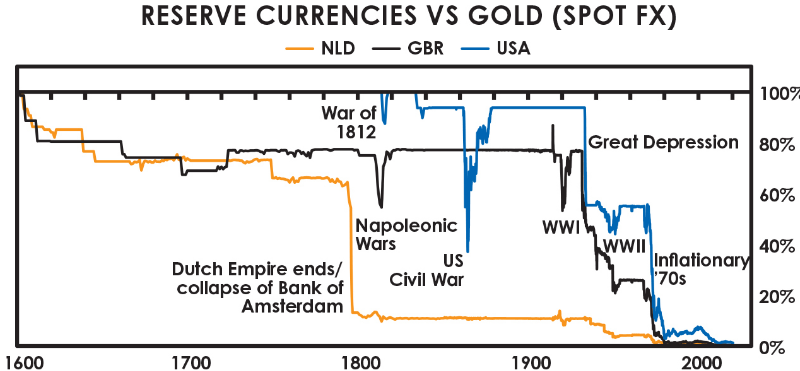
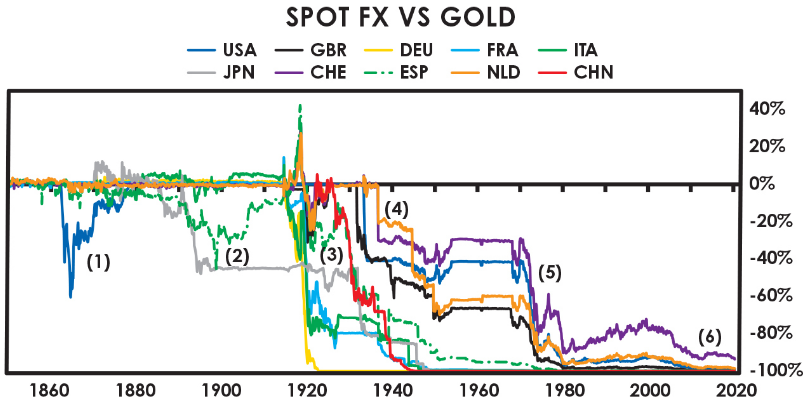
- Currencies begin close to value of gold, then fall away as they are devalued.
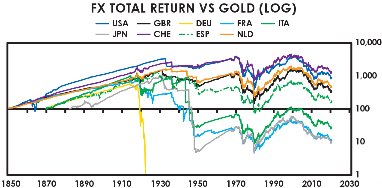
-FX Total return = Price change + interest
- Wars force deficit spending and forces printing $ to devalue currency and monetize debts.
- Breton woods after WWII pegged USD to gold and other currencies to USD until 1971. Losing WWII countries had currencies destroyed.
- excessive spending and debt creation in US forced breaking link to gold
- fueled inflation of 1970s and debt crisis of 80’s
- excessive spending and debt creation in US forced breaking link to gold
- Currency gradually devaluing vs. gold since 2000’s because interest rates low vs. inflation. Interest rates have not provided sufficient compensation for the increasing amount of money and credit.
1850 - 1910
-
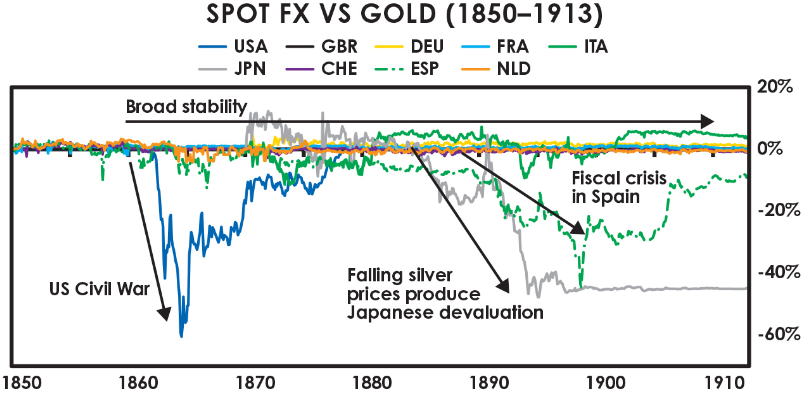
- devaluations are typically abrupt
- price of gold vs. currencies relatively stable from 1850-1910. High interest rates, but fast innovation in second industrial revolution produced high returns. Popping bubbles caused end of this era.
- Gold standard in this period. ($ exchangable for gold)
1910 - 1930
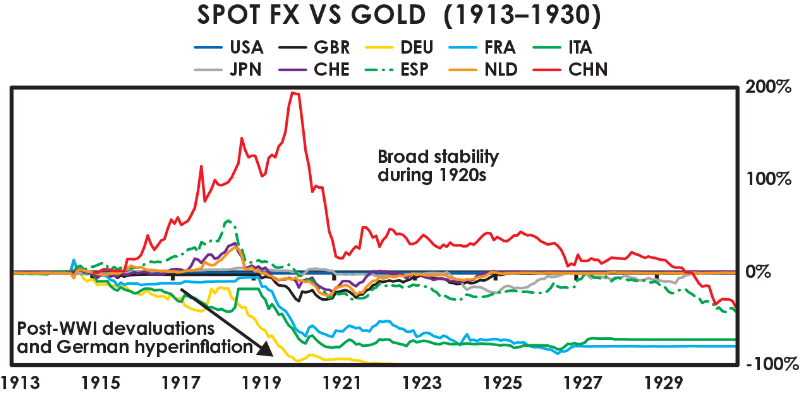
- After WWI, allied europe owes US lots of war debt.
- They inflated & devalued, we didn’t.
- Axis devalued much more. Esp. Germany and Italy
- Led to roaring 20’s and then big debt & asset bubbles and wage gaps.
1930 - 1950
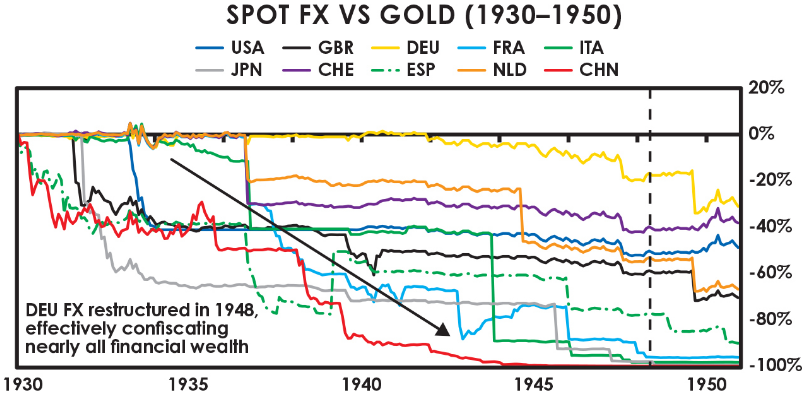
- Since 1950s, downward pressure on currencies vs. gold. Because rate of innovation couldn’t keep up with interest rates like in industrial revolution? requires some inflation vs. gold.
1956 - 1977
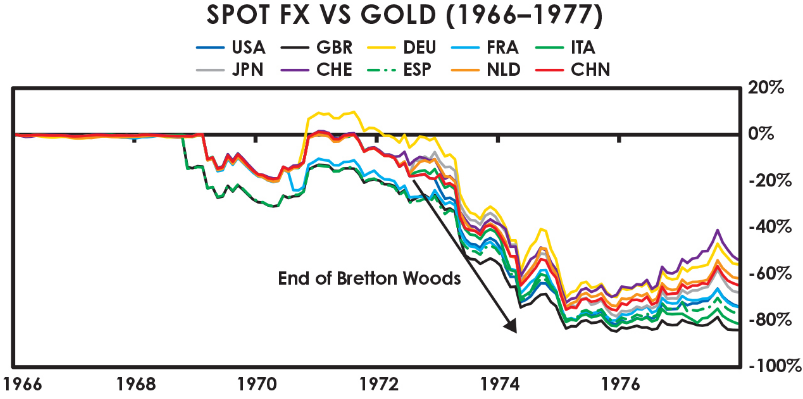
- End of breton woods allow us to deflate from gold more easily
1977 - 1998
- What happens here? He skipped over it. Large inflation in USA, and globally? So more significant devaluing vs. gold since there is significant upward pressure.
1998 - Present
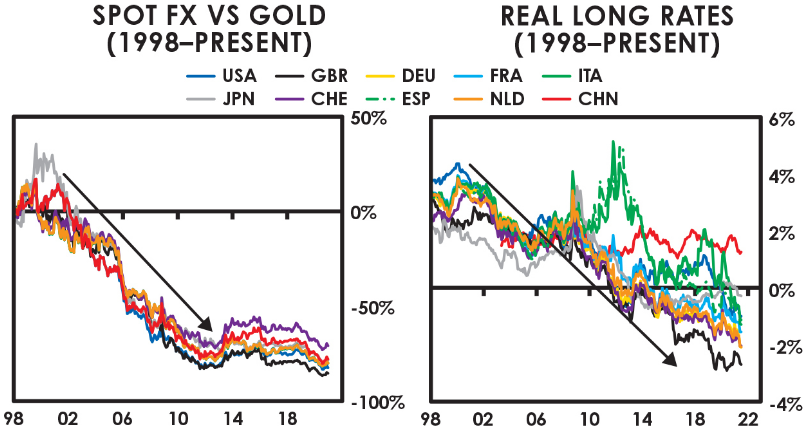
- Broad drop in currencies vs. gold.
- Correlated to lowering interest rates.
Summary
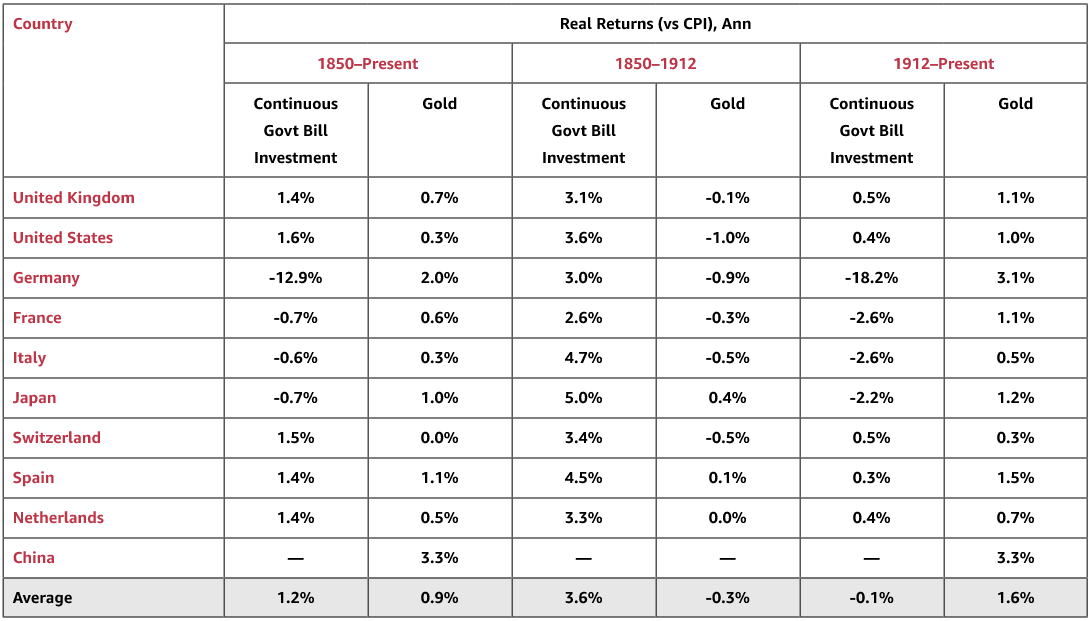
- USA was best place to put money from 1850 - Present. Most innovation and productivity growth. Especially 1850 - 1912.
- Modern era (since 1912) there was a higher return to hold gold vs. holding gvt issued cash. -0.1% vs. 1.6% when compared to CPI
- Amount of goods purchasable went down, but fluctuation in currency makes that vary from country to country

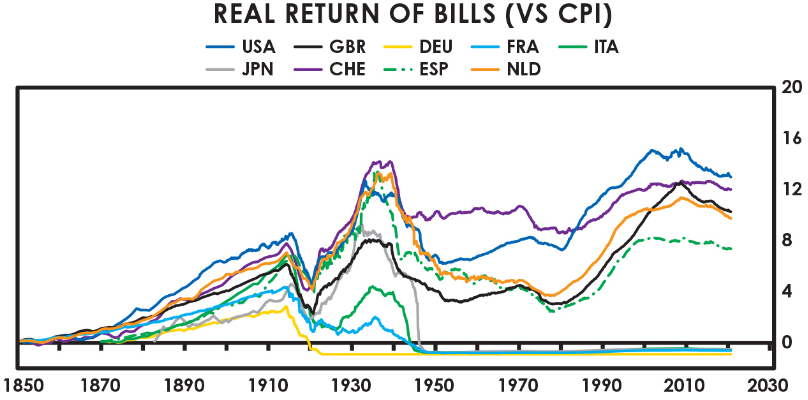 Currency vs. CPI
- Above figure is return of gold vs. CPI and Currency vs. CPI.
- Gold vs. CPI
- Why does Germany have such a steep increase in gold vs. CPI? after WWI they had high inflation. Price of basket of goods goes way up w/r/t while value of gold stays the same. So gold becomes more valuable there.
- US and Swiss stay near 100. This means they’re the most stable w/r/t gold. No currency devaluations since 1850. Currency devaluation increases gold returns w/r/t CPI.
- Currency vs. CPI
- US first, then Swiss. All major currencies currently devaluing vs. CPI. since 2008 when interest rates were near 0.
- Real interest rate. Higher it is, the better prospect of future economic returns.
- Risky to hold interest-earning cash currency late in debt cycles. Because inflation will outpace it and reduce your buying power.
- Gold vs. CPI
Commonalities in devaluations
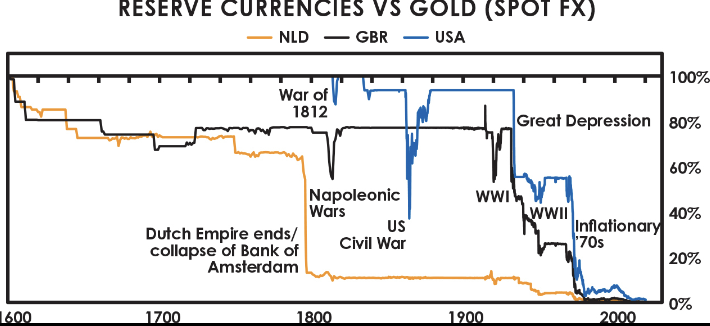
- “run” dynamics on central banks. More claims than cash available to satisfy them. Usually gold.
- Central bank reserves decline years ahead of devaluation. To try and keep party going
- Run on currency/devaluations occur alongside debt problems
- Central banks increase rates to reduce devaluation, but eventually stop because of economic pain, then print again.
- Economic and Military power at time of devaluation determine how much other countries have faith in the devaluing country, so helps those countries keep reserve status and keep devaluations more gradual.
Ch 4 discussion
-
FED was designed to keep the central bank from printing money Willy Nilly. Does it’s existence help prevent end of long term debt cycle since they’re (theoretically) politically isolated from the people incurring debt for the gvt (congress)? How political is the FED these days?
-
Seems like US right now is close to the currency breakdown criteria below. Low interest rate environment pushed us there?
- Amount of debt and money are too large to be turned into real value (I.e. goods and services) they are claims on
- Interest rate level to keep debtors from bankruptcy is lower than the rate required for creditors to put money into that debt
- Central bank interest rate changes (MP1) and QE (MP2) don’t work
-
In table, how does the gold value change in each country? Isn’t it supposed to be a global market with the same price everywhere?
-
Referring to table again, Gold return vs. CPI is because its gotten cheaper to make the things that make up the CPI, right? Productivity measurement.
-
When referring to “interest earning currencies”, that means the interest rate of countries that issue the currency, right? Not private debt that is issued by people/banks?
-
Gold vs. CPI
- Why does Germany have such a steep increase in gold vs. CPI? after WWI they had high inflation. Price of basket of goods goes way up w/r/t while value of gold stays the same. So gold becomes more valuable there? compared to bills?
Ch 5: The Big Cycle of Internal Order and Disorder
6 stages of the internal cycle
![[assets/Dalio-Principles-for-dealing-with-the-changing-world-order/Dalio-Principles-for-dealing-with-the-changing-world-order-image-21.jpg]]
- Cycle repeats over time and winners/losers adjust how other countries align themselves moving forward.
Stage 1: New Order Begins, Power Consolidated
- Revolution/war/conflict comes in 2 parts, the actual fight and then the purge from power of those loyal to the losers of the conflict
- The purge can be quick or drawn out. Peaceful or bloody.
- If respect for the system is maintained, it can be peaceful like in US civil war and Roosevelt revolution
- This period ends when new authorities are clear and people are tired of fighting and rather focus on rebuilding
Stage 2: Systems are Built and Refined
- Even losers of war need to go through this
- Beginning of peaceful and prosperous period.
- Must align people to common goals with respect of rules and laws.
- ESP. Middle class. Leads to more cohesion
- Revolutionary leaders not necessarily good system-building leaders.
Stage 3: Peace and Prosperity
- Abundance of opportunity to be productive, produce a lot, get rich, admired for success.
- Wide access to education and meritocracy
- Debt growth increases productivity, increases incomes, excess savings=more investment.
- Entrepreneurship, innovation, strengthening military
- Avoiding external conflicts is important.
Stage 4: Period of Excess
- Debt financing outpaces future cash flows.
- Asset bubbles emerge. People assume trends continue so valuations increase, borrow more to buy more to increase asset prices +more leverage = bubbles.
- More spending on luxury and military, less on R&D
Stage 5: Bad Financial Conditions + Conflict
- Inequality, bad balance sheets, class conflict. How this is handled determines if stage 6 is peaceful or violent
- Best predictor of civil war/revolution =bankrupt gvt + wealth inequality
- If gvt has good finances, it can save private entities to keep system running (TARP)
- police become political weapons. Many protests and they’re progressively more violent
- 2 types of leaders to get us out of stage 5: peacemaker who joins factions. And strong fighter to start civil war
Stage 6: Civil Wars
- Most civil wars shift power from right to left, but some do the opposite, like axis powers in WW2
- gvt usually has a shortage of money in civil war so they impose capital controls to keep money in the country and keep the currency strong
Ch 6: The Big Cycle of External Order and Disorder
- 5 types of wars:
- Trade/economic - tariffs, import/export restrictions
- Technology - conflict over what tech is national security
- Geopolitical- conflict over territory, solved with negotiation
- Capital - sanctions, limiting access to markets
- Military - shooting war
- Cycles of conflict ~every 150 years with relative peace &rising tensions between
- Financial strength wins conflicts
WWII Case Study
Axis Powers
- 1930s countries have large economic problems and internal orders become more populist. Germany, Italy, Spain, Japan populist of the right (fascist)
- Hitler got to power in 1933 and became supreme leader with all the special powers. Forced banks to buy gvt debt and used the $ to finance infrastructure projects and privatization.
- Unemployment from 25% to 0 and income per capita increased 22% from ‘33-‘38
- Japan resource constrained, so they took resources by force from china after internal revolt and move to fascism
Allied Powers
- The US banks stopped lending, increased tariffs to protect domestic industry, hurt all other countries as well
- Droughts in Soviet Union and US
- FDR’s new deal increased debt and deficits and taxes on the rich to finance huge gvt spending programs. GDP grew 9%/yr from ‘33-‘36
- This caused inflation, which the fed raised interest rates to fight. Caused more tensions between countries
Conflict
- This caused inflation, which the fed raised interest rates to fight. Caused more tensions between countries
- Axis and Allied powers fighting economically ~10 yrs before hit war. Germany and Japan became more expansionist. Economic war:
- Asset freezes/seizures - preventing rival from selling assets to fund itself
- Blocking access to capital markets
- Embargoe/blockades - blocking trade
- The US froze Japanese assets, restricted Panama Canal to Japanese ships, cut off oil trade. Forced japan to back down or attack US
- In war, stocks perform based on who is winning. Germany up in the beginning and US&GB up when tides turned
- Wars financed by debt and printing money. Hold gold in these times
Ch 7: Investing in Light of the Big Cycle
- Markets are driven by: growth, inflation, risk premiums, and discount rates
- discount rate - interest rate for a given risk premium
Financial history
- discount rate - interest rate for a given risk premium
- Lending with interest outlawed by Abrahamic religions. Currency is “hard” - gold & silver. No real financial markets
- 1350 - beginning with Medici family in Florence- credit creation. Creates lots of buying power
- Creating credit is near term stimulating and long term depressing. Broken promises to pay in the future (credit) causes debt default depressions and market crashes
- 50 years before WW1 was extreme productivity growth and wealth creation and globalization. Couldn’t predict 7 of the top 10 countries would see their wealth wiped out completely.
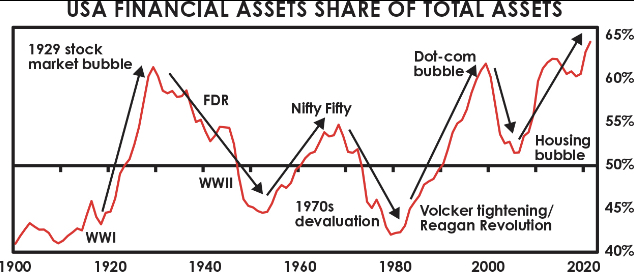
- financial assets inflating vs. real assets causes the big cycle. i.e. printing money reduces debt burdens but requires bad returns for cash and debt assets to monetize debts, which is the negative slope times in the chart above
Ch 8: The Last 500 Years in a Nutshell
World was same but different:
- Max travel in a day was 25 mi on horseback, so world was very segregated by geography
- Age of exploration beginning to change this
- Territories ruled by families, no countries exist. Constant fighting to keep borders
- Religious leaders more powerful
- World much less egalitarian
Europe
- Habsburg dynasty largest. Old Holy Roman Empire.
- France, England, Russia, ottoman empires also family dynasties.
- Italian places (Florence, Milan, Venice ) were republics and was where all the wealth/innovation was.
Asia
- Ming dynasty in China, most technologically advanced in the world, same family dynasty structure as Europe
- double the population of Europe
- Gunpowder, printing press, banking, corporations, paper money, high literacy
- Largest navy in the world and 1M standing army
- India and Japan and rest of Asia fragmented and not powerful
Middle East
- Ottoman Empire
Americas
- Aztec and Incan
Africa
- Fragmented. And separated by large areas of unpopulated areas.
Economic Ages
Commercial Revolution
- 1100s-1500s. Shift from only agriculture to include trade
- Christian/Islamic conflict made land trade hard so sea trade took off, esp in Italy city-states. They also were republics so more nimble
- Merchant class in Italy benefit most from well functioning financial system so they improved bookkeeping and credit markets and contract enforcement
- Venice created perpetual bond in 12th century with 5% rate. Was able to do this because of solid currency based on trade wealth
- Bonds not new but these were much more reliable so less default and very liquid
- Ability to borrow quick with good rates was a huge boon to Venice
The Renaissance
- 1300s-1600s. Started in Italian city states and spread to all Europe.
- The rich invested in arts, tech, and culture to increase their wealth and of their city in a self reinforcing cycle.
- China’s neo-Confucianism was like their renaissance and happened much earlier
Age of Exploration and Colonialism
- 1400s-1700s. Fed on advancements from renaissance and kept it rolling.
- Expanded empires and their wealth. Influx of silver from new world increased inflation a lot in Spain for first time.
- More trade to China began. Silver for their goods. Not enough silver for Europe’s demand which led to wars.
- China flirted with exploration but eventually abandoned it and closed off, like Japan.
The Reformation
- 1517-1648
- Christian Protestant reformation broke down existing symbiotic relationship between Catholic Church and nobles and monarchs.
- After many religious wars and millions dead, Protestants won many rights and freedoms. But now many deep divisions.
- End of 30 years war led to nation states with geographic borders and sovereign rights for those living inside. Peace of Westphalia.
- Dutch leading power after this
- They invented capitalism with public equities to more efficiently allocate buying power to entrepreneurs
Scientific Revolution
- They invented capitalism with public equities to more efficiently allocate buying power to entrepreneurs
- 1500s-1700s. Extension of renaissance. And invention of scientific method and gvts started to support research.
First Industrial Revolution
- 1700s-1800s. Machine-based manufacturing/agriculture. Led to urbanization and self reinforcement
- UK led due to key innovations. Caught up to Netherlands by 1800 in per capita output.
- Urbanization required expansion of government to provide services/infrastructure for city population
- New industrial capitalist system also required gvt infrastructure like courts, regulators, central banks etc.
Age of Enlightenment and Revolutions
- 1600s-1700s. Scientific method applied to how humans should behave.
- Increased individual rights, decreased rights to monarchy and church
- American, French, Spanish, German, Portuguese, Italians all had revolutions.
Napoleonic Wars and New World Order
- 1803-1815. Pax Brittanica - extended peace after defeat of Napoleon and British on top
West Moves into Asia
- 1800s. British and US force Asia to open to trade. Led to modernization in Asia and Brit’s controlling India.
Second Industrial Revolution
- 1850s-early 1900s. Railroads, electricity, phones, interchangeable parts, etc. America is big winner. Large wealth gaps and leads to gilded age
Invention of Communism
-
- Reaction to capitalism and wealth gaps created.
Ch 9: The Big Cycle Rise and Decline of the Dutch Empire and the Guilder
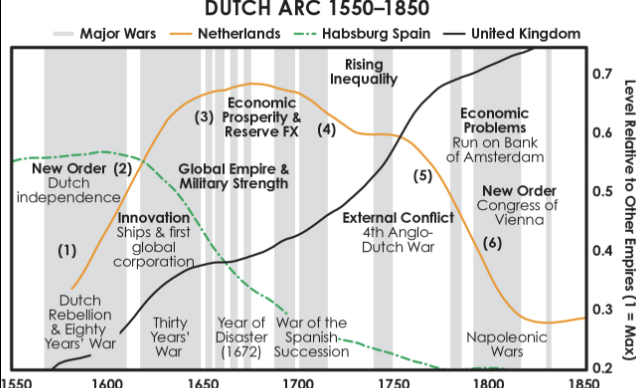
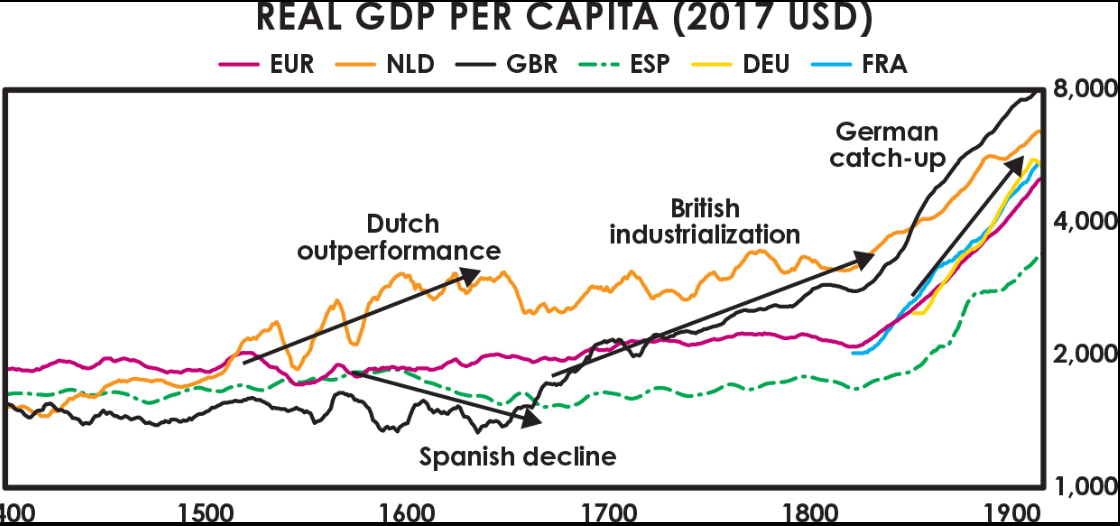
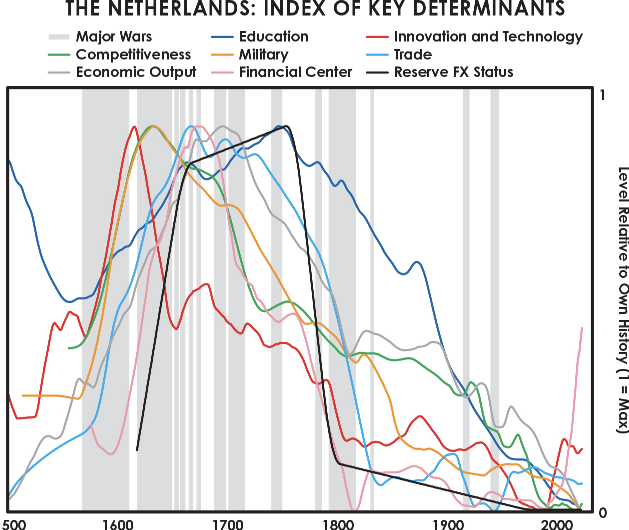
- Spanish/Habsburg was the great power before Dutch. Due to wealth and power from age of exploration. Spanish was almost a reserve currency but they overextended in mid 1500s and followed the traditional downward spiral.
- Religious and inequality are reasons for internal conflict.
- Holy Roman Empire split into two after conflict and weakened it.
- Hapsburg was Spain, Netherlands, Belgium, and part of Italy.
The Rise
- Provinces were United during fight for independence from Hapsburg
- Provinces kept power which put in checks & balances to gvt
- Good ships and strong military helped trade
- Capitalism helped finance productive enterprises
- Reserve currency - guilder bank note - first reserve currency other than gold or silver
- Stock market began with Dutch east India company to share risk and profits.
- In 1500s, >800 different coins, some debased (reduced precious metal content), some not
- Dutch created an exchange bank to protect their merchants from debased money and reduce cost of trade.
- Guilder was backed by gold but worked as type 2 money
- Guilder caught on for its trustworthiness and the world began using their notes
- Peace of Westphalia ended 30 years war (1618-1648) and created the idea of sovereign states with Hapsburg losing and Dutch becoming independent
The Top
- large empire was overextended & indebted and more military conflicts
- British leading Industrial Revolution and overtook Dutch. Lost reserve currency status after war with Brits
- most wars were over trade/trade routes
- 40% of global trade was settled in guilders at peak
The Decline
- Rich Dutch began moving money to London due to higher returns and growth
- Quinn & Robert’s - the bank of Amsterdam through the lens of monetary competition
- British and other countries stole Dutch territory and trade routes. Dutch east India trading company lost 1/2 of ships and needed to borrow a lot from bank of Amsterdam to stay alive.
- Bank printed money to help east India trading company monetize debts. But it led to runs on the bank because people scared their money would be worthless and they took out gold instead
- Devaluing Guilder forced other investors to other stores of wealth away from guilder, ending reserve currency status.
- Bank printed money to help east India trading company monetize debts. But it led to runs on the bank because people scared their money would be worthless and they took out gold instead
Ch 10: The Big Cycle Rise and Decline of the British Empire and the Pound
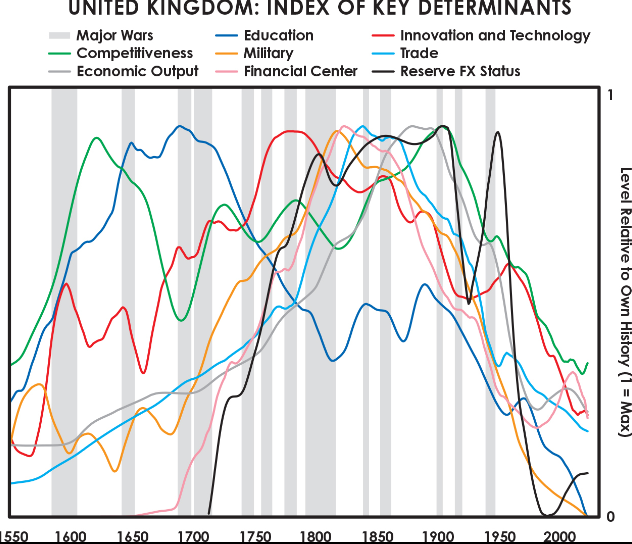
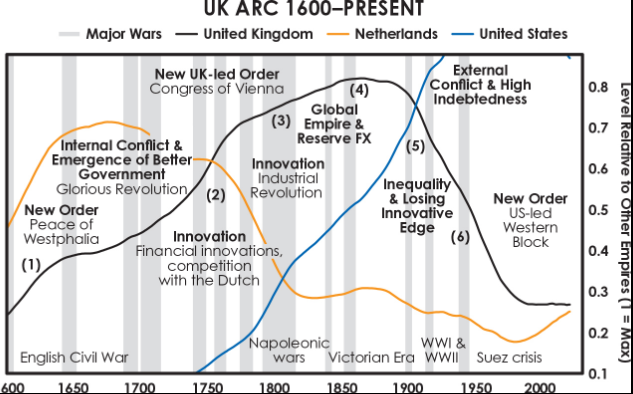
- At its peak, UK was 2.5% of world population, had 20% of world income, and controlled 25% of the land
The Rise
- British civil war overthrew monarchy and rule of law prevailed
- Gvt built on enlightenment ideals. Books now available because of printing press. Education high. Helped them become innovative
- UK bond yields low in mid 1700s late 1800s due to stable economy
- Industrial Revolution major driver. People move to cities to work in factories and forced gvt to be bigger and create more services
- strong navy helped them have lots of trade and colonies so $ kept flowing and navy bigger
-
Why not France?
- Gvt financing not as good. Had a bubble in French trading company and forced gvt to fund itself with higher taxes and high rate loans
- lots of expensive wars that didn’t pay off
- Very high inequality that eventually led to war against the nobility.
- After Congress of Vienna in 1815, France was restored to its old borders and peace created for next 100 years
British Peak
- No major wars so UK kept trading and stacking up wealth. Countries traded in the pound.
- Bank of England was lender of last resort to stabilize panics
- UK didn’t keep up in 2nd Industrial Revolution and US & Germany overtook it in innovation
- inequality peaked in late 1800s with top 1% owning 75% of wealth. Sowed seeds of conflict and leads to labor movement, increases in social services and more democratic representation of bottom
The Decline
- after WW2, British in debt and spending more on colonies than they make
- Took 20 yrs for USD to overtake pound after WW2
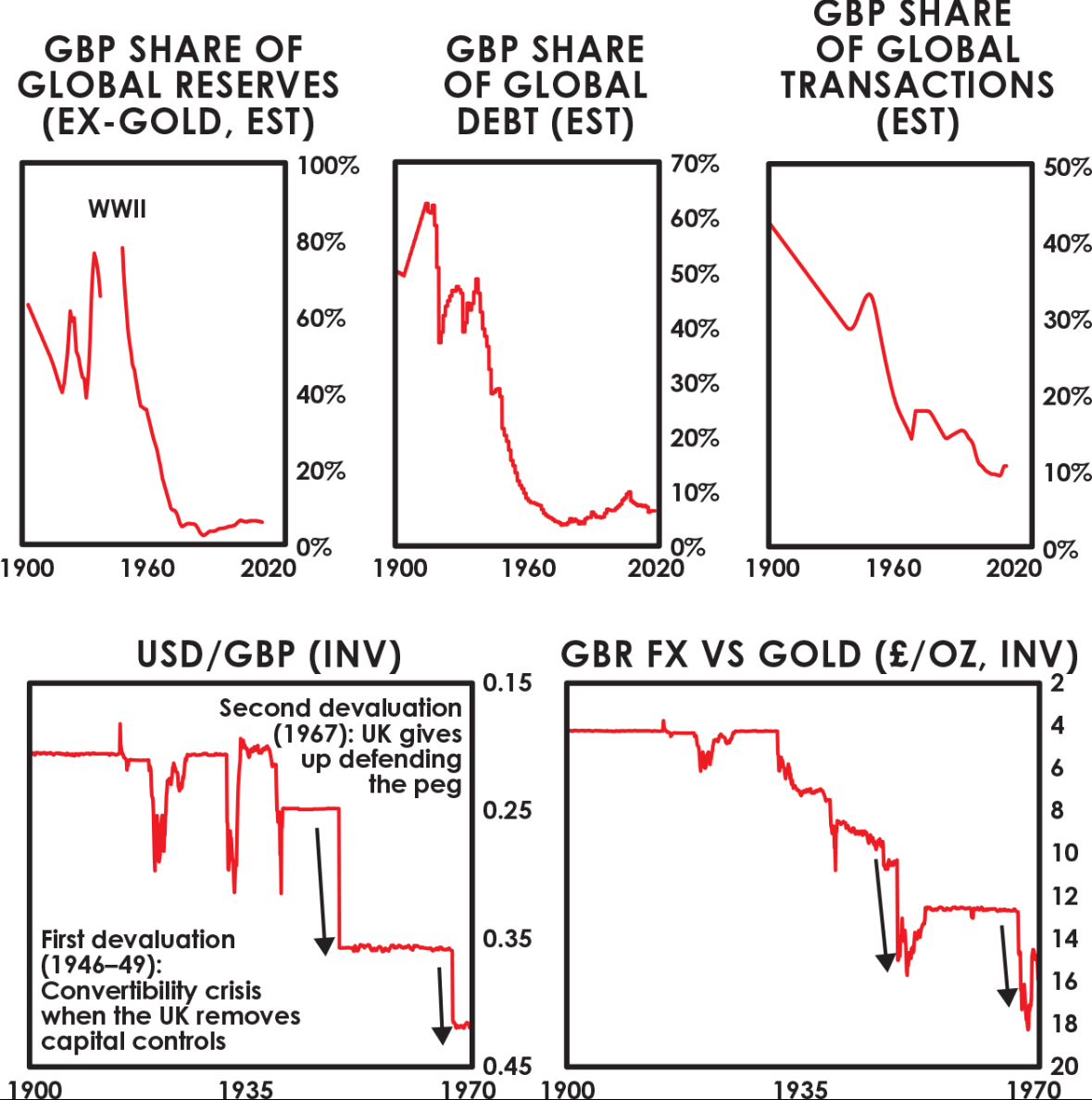
- US was trying to be nice to UK and provided a loan to them when restoring partial convertibility to protect against a run, but devaluation against the dollar was the only way to restore full convertibility, eventually unpegging from the dollar in 1967
Europe After WW2
- EU started as a coal and steel economic pact between major European countries.
- After that, supranational bodies for representation, justice, taxation, loans and welfare formed.
Ch 11: The Big Cycle Rise and Decline of the United States and the Dollar
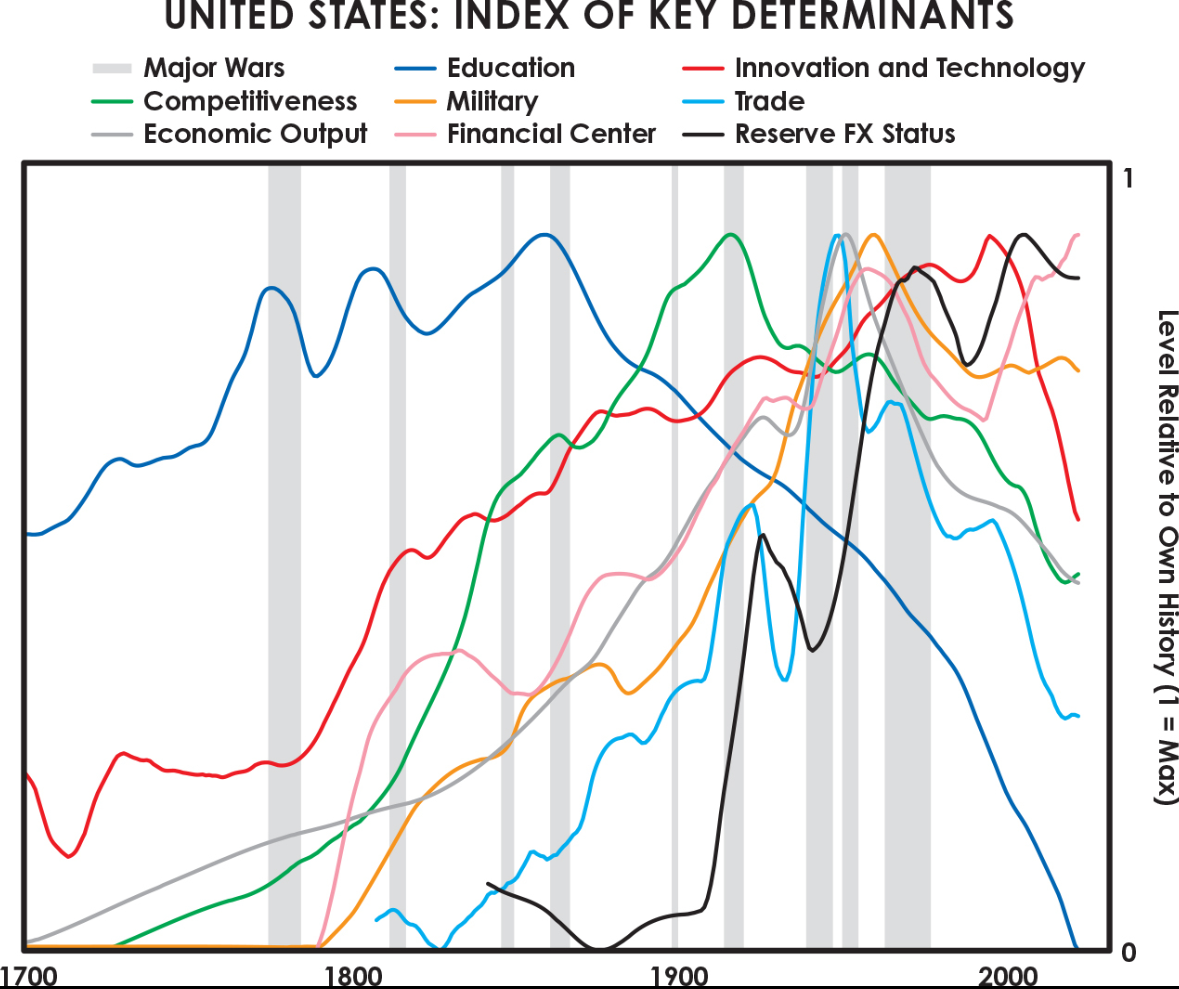
The Rise
- After civil war, second Industrial Revolution created great wealth in USA.
- Created large wealth imbalances which brought about progressive policies and income tax
- After WW1, major powers couldn’t keep gold convertibility in their currencies except the US. Helped USD because foreign powers were keeping USD to pay debts.
- US was also the one that provided loans to W Europe which boosted USD for global gvt debt
- US also big winner after WW2 for similar reasons to WW1
The Top
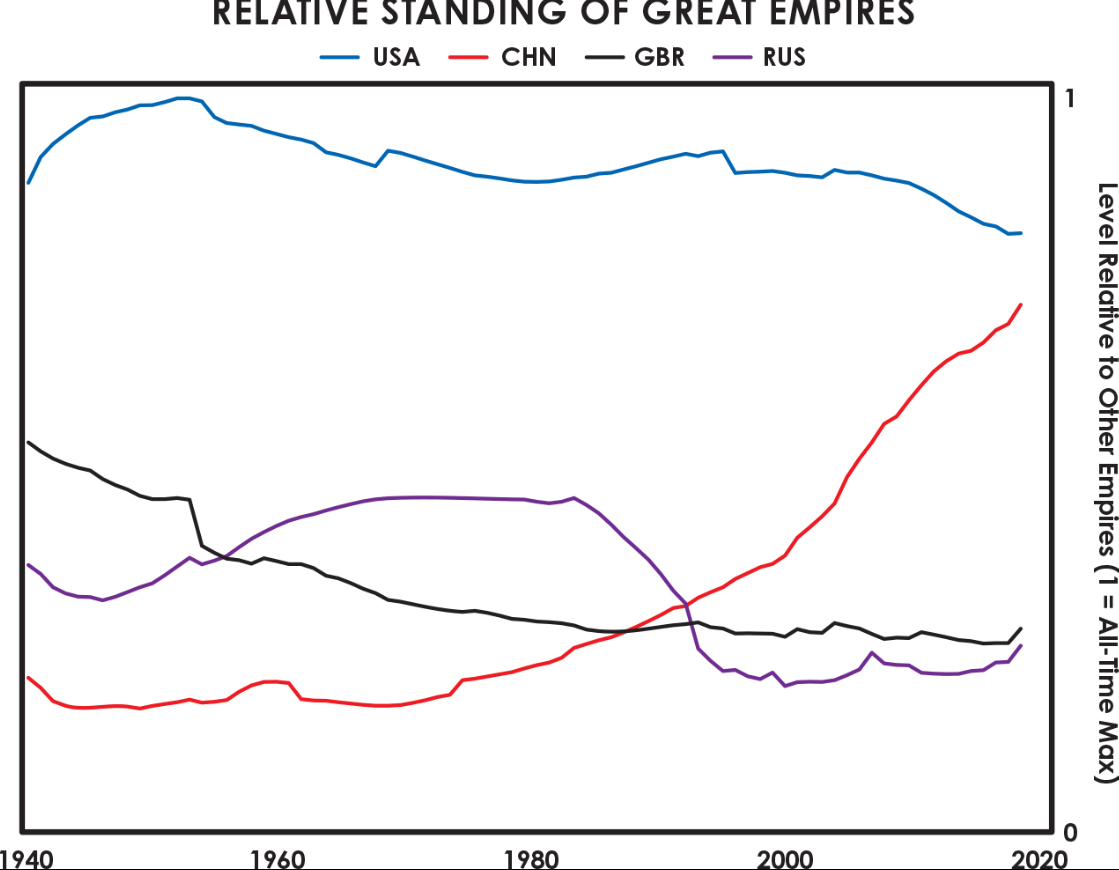
- Modern wars are going to be won by economic and technology wars because those fund the military and the money to compete globally to outlast the enemy
The Post War Monetary System
- After Bretton Woods, USD is world reserve currency. Post war countries were buying US goods with aid money from US and Holding USD in a self reinforcing cycle.
- there was a quick post war recession with reshuffling from war to peacetime economy. After that economy boomed with stock market and increased foreign investment.
The 1970s: The Balance of Payments Problem unfolds - Low Growth, High Inflation
- around 1970, big balance of payments deficit. Imports > exports
- Nixon broke gold peg to dollar and offered USD instead
- This allowed US to keep printing which kept interest rates lower to give Americans more buying power.
- US deficits went to countries with surpluses which deposited $ into US banks which invested in emerging economies.
- Savings and Loan Associations borrowed short and lent long, exploiting low rates.
- When geopolitical issues arose (Vietnam war, watergate, OPEC-induced oil $ spikes, drought-induced food $ spikes) more printing and inflation occured to keep ship afloat.
- Savings and Loan Associations borrowed short and lent long, exploiting low rates.
- Nixon broke gold peg to dollar and offered USD instead
The Post-Bretton Woods System
- USD gold conversion suspended 1971.
- After inflation spiked in 70s chaos, conservative leaders took over in many countries with austerity
- Value of assets = 1/(value of money + credit)
The Disinflationary and Booming 1980s
- Interest rates raised high and caused inflationary depressions in debt-burdened emerging economies with many debt defaults since there was no central bank to bail them out.
- Dollar reserve currency through whole world at this time and US was able to dictate policy to fix our inflation issue. Other countries with dollar denominated debt did not have the ability to adapt and struggled to repay
1990-2008: Globalization, Digitization, and Booming Financed by Debt
- When interest rates hit zero, assets inflate and expand wealth gaps
Ch 12: The Big Cycle Rise of China and the Renminbi
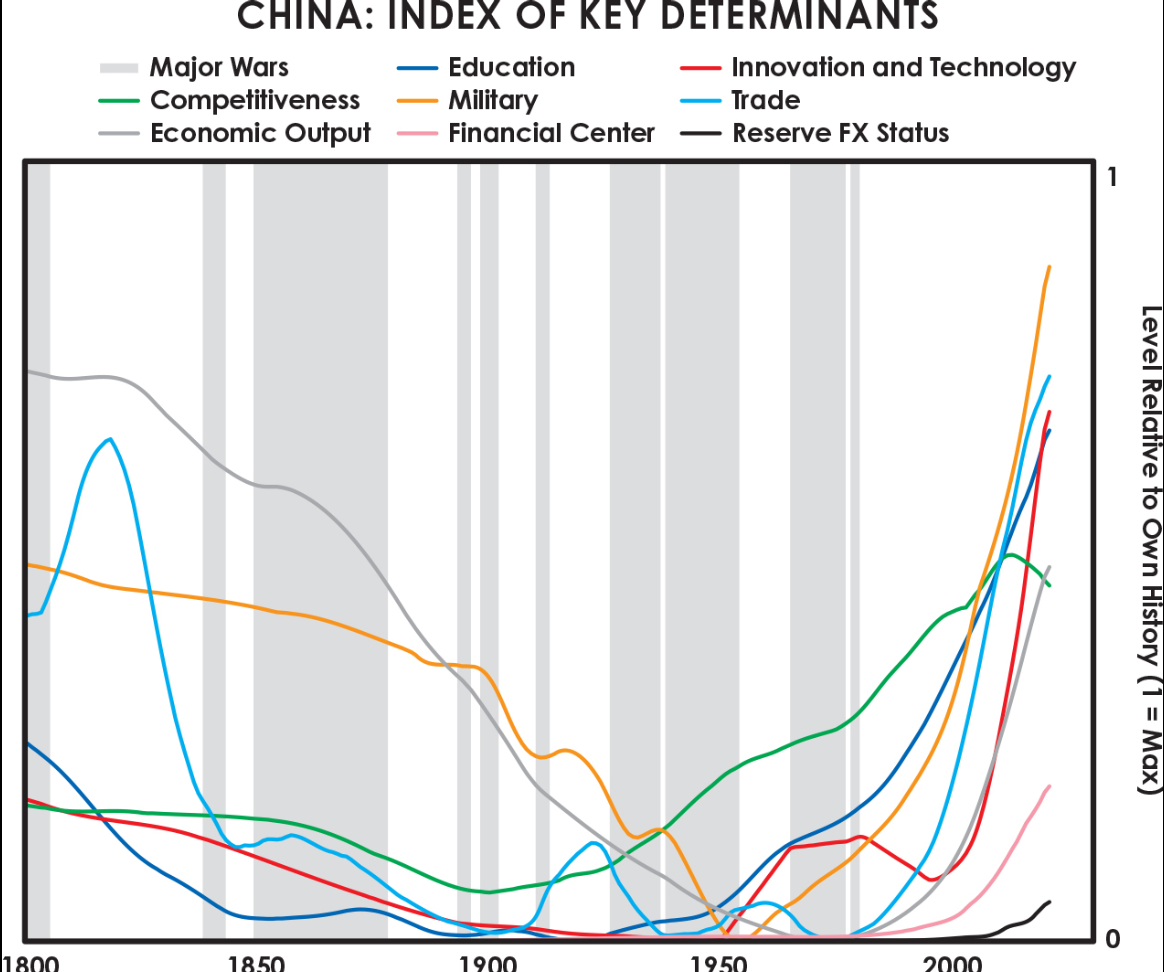
- Growth from 1980s to 2008 was not fueled by debt. It grew with economic growth after opening economy
- Before communist China, dominant philosophies were:
- Confucianism- respect your leaders and your place
- Legalism - fascism
- Taoism - harmony with nature
- All were hierarchical and non-egalitarian. Prizing the collective over individuals
China’s Monetary and Economic History
- China as gone through many cycles of all 3 types of currency: metal coin, paper backed by metal, and unpegged paper
- Currently unpegged paper
- In 1100’s first commodity-backed paper money introduced. Following were many cycles of overprinting, inflation, and retreat to hard money after currency collapse
- China’s never been a global reserve currency
- never a big world power.
- Established first stock companies and paper money, but financial/capital markets in Europe more developed by 1600
- Scholars regarded higher than entrepreneurs. Less industry and innovation from that
- Not much state investment in important industries in beginning
- currency is real valued if it trades at the same rate domestically and internationally
- by definition reserve currencies must trade the same
1800-1949
- British paid for Chinese goods in silver. When they ran out of silver, they smuggled opium into China for silver and then used that silver to pay for Chinese goods
- Qing dynasty was in big debt and many internal wars until 1949 when Mao & communism won
1949- now
- Mao, Deng Xiao Ping, Xi Jinping
- Mao opened China to trade with the US in 1971 to deter the Soviet Union. US didn’t want China to become Soviet, so we were also incentivized.
- Deng set up reforms to make China less dependent on the leader. Set up politburo, politburo selection process, term limits, etc.
- Deng’s opening up made China much richer and made people interacting with China richer too.
- Peace while all involved were benefiting.
- During globalization in early 2000’s - 2016, US would buy cheap goods from China and China would loan the US $ to buy it. Helped build savings and wealth for china
- After 2008 recession, G20 countries printed money to finance economic stimulation. Debt growth in China » economic growth after GFC
- Xi Jingping has been consolidating power because he/politicians see harder times ahead and it’s better to have a continuity leadership in times like that.
Ch 13: US-China Relations and Wars
- partners are buying us bonds but they have negative real rates because we need to monetize our debts. I.e not beating inflation
- US complaining about:
- Chinese markets closed to us goods
- Gvt support for domestic industry
- Chinese stealing IP
- both countries pushing towards decoupling. China more at risk than US for 5-10 years until they get their own access to advanced technologies the US has control and influence over
Comments