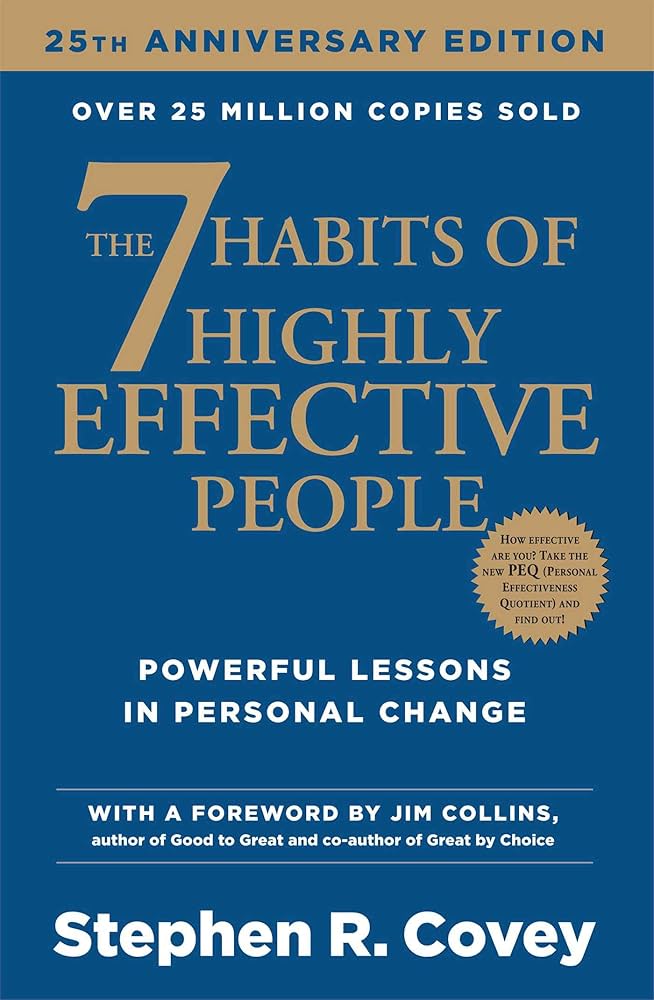
Preface
- Habits 1-3 are personal improvement. My wins
- Habits 4-6 are teamwork improvement. Our wins
- Habit 7 is continuous improvement
Ch 1: be proactive
- 3 paradigms for human conditioning:
- Nature- your grandparents genes determine your behavior
- Nurture - your upbringing by your parents determine your behavior
- Environment - the people arou[[]]nd you and they way they treat you determine your behavior
- In reality, the gap between stimulus and response is where you excersize your free will and how things affect you.
- Viktor frankel discusses the freedom he had in concentration camps by his imagination and internal dialogue. More free than the guards
- be proactive because your responsible.
- Ability to subordinate impulse to a value
- reactive people driven by feelings, circumstances, conditions, environment.
- Proactive driven by values selected and internalized
- “have vs be”. If only I had ___ is victim language. I can be __ has agency and respnsibility
- circle of influence = things you can affect
- Circle of concern = things you worry about but can’t affect.
- Effective people focus on circle of influence and by doing this it grows and so does their circle of concern.
-
Ch 2: begin with the end in mind
- Everything is made twice. Once in planning and another in doing
- Leadership is having vision and moving there. Pointing the ladder to the right wall. Management is building the ladder. Pointless if not building towards the right wall.
- Personal mission statements help define your values and your rudder that keeps you centered.
- Security guidance, wisdom, and power are the 4 axes for having values drive your life
- There is something that is the primary author, if not you it is someone else or some other feeling you’re searching for.
- Common non-internal value drivers
- Children
- Spouse
- Money
- Possessions (&status)
- Work
- Hate
- Many of these are good aims, but alone they force you to be unstable and dependent on others for you fulfillment instead of it coming from inside.
Ch 3: Put First Things First
- Operationalizing ch 2. Managing your day to day tasks in alignment to your mission statement
- need to delegate effectively to build relationships stronger.
- “Gofer” delegation is very micromanage-y and people don’t have ownership.
- Stewardship delegation gives people ownership and they feel responsible for outcomes.
- 4th generation of time management?
- Schedule your weeks out. Not days/hours. Need to write out roles and your goals in those roles for the week
-
Ch 4: Think Win-win
- Emotional bank account builds up over time dealing with individuals. Need to make deposits so one day we can ask for favors and make withdrawals.
- Abundance mindset required to think that both parties can win.
- Better to have no deal than not win-win. Later can come up with better win-win
- Win-loose is a non-collaborative mindset. Win at all costs. Zero sum.
- Loose-win is being compliant and letting the other person win because you respect them or feel bad or don’t communicate your winning criteria
- Many people oscillate between win-loose and loose-win in their relationships.
- To operationalize win-win need to have systems and reward it. Can’t only look at hard metrics and expect interpersonal communication to improve.
Ch 5: Seek first to understand, then to be Understood
- empathic listening is a big deposit into emotional bank account
- Understanding first makes you vulnerable since you’re able to be influenced by it. But it’s the only way to gain any influence over the other who is communicating
- first, mirror what the other is saying. Then mirror their feelings about what they say. Don’t interject unless they ask for advice
- Most common way we communicate is through our autobiography. We judge, advise, etc before really listening to the underlying problem and cause the other person to completely close off
- understanding / listening and showing it is big emotional deposit
- Probing, evaluating, advising, interpreting are autobiographical responses that don’t help
- if you’re trying to use empathic listening, be honest and tell the other person. But only if genuine. This goes a long way to signal the intentions are pure since people can feel like you’re trying to manipulate
Ch 6: Synergerize
- synergy is possible within circle of influence. Within yourself between your analytical and emotional side
- Look for the good in others to improve your point of view
- Use courage to be open and share to encourage others to do the same
- Does someone disagree with you? Good, help me understand.
- look for the 3rd alternative instead of yours and the other.
Ch 7: Sharpen the Saw
- Self renewal is what allows us to keep motivated.
- 4 dimensions
- Physical - workout
- Spiritual - pray and determine your mission statement
- Mental - read books and educate yourself
- Social, emotional - talk to others like they are capable and you believe in them to bring it about.
- The person who doesn’t read is no different than the one who can’t.
- must renew all 4 together in equal proportion. Neglecting one will bring down the rest
- This renewal enables the other habits and the other habits reinforce each other. Upward spiral.
- Every cycle through the habits brings greater depth of understanding
Comments