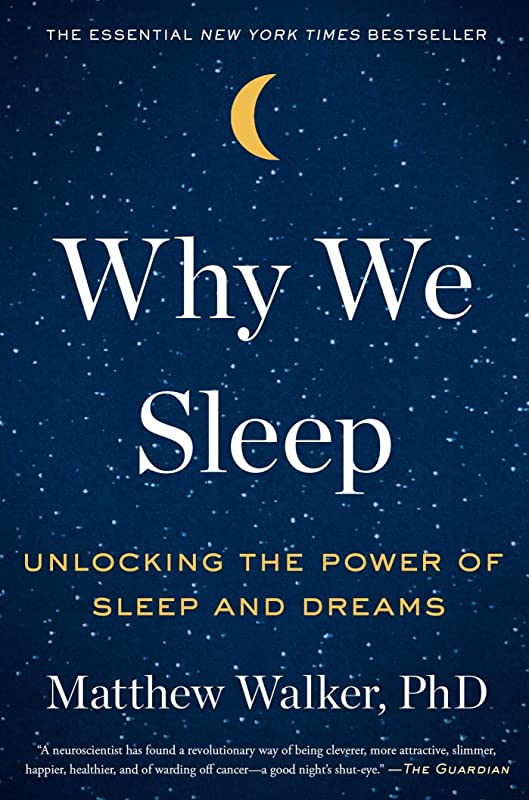
Why We Sleep: Unlocking the Power of Sleep and Dreams
Ch 1: To sleep
- As sleep deficits increase, so do risk for: Alzheimer’s, heart disease, and weight gain hormones
Ch 2: Caffeine, Jet Lag, and Melatonin
- 2 things lead to sleepiness:
- Circadian rhythm
- Sleep pressure from a chemical adenosine
- Circadian rhythm controls:
- Time preference to eat and drink
- Pee
- Body temperature
- Metabolic rate
- Experiment determined that even in full darkness, we have normal sleep/wake cycles. Internal clock =/= 24 hrs. Usually longer. Depends on age
- Sun is not the only clock for circadian rhythm
- Food, exercise, temperature are also clocks
- Body temperature fluctuates over time
- Peak at 4pm, trough at 2am
- Fluctuates whether asleep or not
- Chronotype
- Is genetic (sleep time preferences)
- Night owls are forced to wake early against their internal clocks
- Therefore, less sleep, more health problems, perform worse @ work
- Variability of chronotype helped in evolution. People in clan to keep watch
- Melatonin
- Regulates timing of sleep, not generation of sleep
- Unregulated. pill dosage unreliable
- Is released through the night. Reduction in body signals wakefulness
- Jet lag
- Body can only correct internal clock ~1 hr/day
- Traveling east, jet lag is harder to correct
- Easier to stay up late vs. sleep earlier
- Also bc internal clock >24hrs
- Flight crews have shrunken learning and memory areas in brain bc circadian rhythm super off
- Sleep pressure
- Adenosine builds up all day and pressure builds to sleep after 12-16 hrs awake
- Caffeine bonds to adenosine sites & reduces sleep pressure
- Half life = 5-7 hrs. may produce insomnia
- Enzyme that breaks down caffeine varies genetically
- Crash happens bc adenosine finally binds after caffeine is digested. Bonds harder after caffeine is digested
- Sleep pressure & circadian rhythm independent but correlated
- Caffeine bonds to adenosine sites & reduces sleep pressure
- Adenosine builds up all day and pressure builds to sleep after 12-16 hrs awake
- Pulling an all nighter increases adenosine continually, but circadian rhythm continues
- Urge to sleep can decrease next day bc of circadian rhythm
Ch 3: Defining and Generating Sleep
- Senses still work while asleep, but thalamus in brain blocks them
- We can determine time while asleep unconsciously
- But time in dreams feel longer than actual time
- In rat experiment, brain signals recorded in maze
- In sleep, same waves present, but @ slower speed
- Evidence time moves slower in dreams
- In rat experiment, brain signals recorded in maze
- But time in dreams feel longer than actual time
- 2 types of sleep: REM & Non-REM. cycles and repeats overnight
- NREM has 4 stages, each harder to wake from than the last
- Cycle takes ~90 mins in humans
- Other animals typically have shorter cycles
- Best correlation is to width of brain stem
- Cycle more NREM heavy at first, then more REM at end of night
- Could have to do with consolidating memory
- NREM takes out unnecessary connections, REM strengthens connections
- Could have to do with consolidating memory
- Other animals typically have shorter cycles
- Sleeping late & waking normal makes you loose NREM @ beginning of night
- Sleeping normal & waking earlier makes you loose REM @ end of night
- Brain signals when awake are asynchronous ~30-40 Hz
- Because brain is working fast to keep up with sensory input
- Brain signals in deep NREM sleep slow down 10x & are more repeatable
- Hidden in slow activity are “sleep spindles” which are occasional fast cycles
- Helps to reduce external noise that could wake us
- These signals come from center of frontal lobes and radiate front to back
- Neurons all fire in sync
- Thalamus cut off senses in NREM - explains no dreams, unconsciousness, and loss of time
- Slow waves can travel farther in the brain and link different parts in NREM
- Hidden in slow activity are “sleep spindles” which are occasional fast cycles
- REM is very similar to wakefulness brain signals
- Wakefulness = reception; REM = integration; NREM = reflection
- Dreams in REM are thoughts/memories being broadcast into senses for building more accurate models of the world
- Body completely limp in REM - good indicator of REM
- So we can act out dreams in head and not in real life
- Wakefulness = reception; REM = integration; NREM = reflection
Ch 4: Ape Beds, Dinosaurs, and Napping with Half a Brain
- Every animal sleeps - insects, reptiles, mammals, invertebrates. sleep >500M years old
- Even bacteria have active and passive phases corresponding to day/night
- Maybe sleep evolved first, then wakefulness?
- Even bacteria have active and passive phases corresponding to day/night
- Big differences between animal sleep times
- Relationship between brain/nervous system size vs. total body mass is an ok predictor
- Also depends on diet, social networks, predator/prey balance, metabolic rate
- REM is a recent evolution of sleep - only birds & mammals
- Dolphins & whales don’t have REM; also seals when in ocean, but when they sleep on land, they have REM
- REM = paralysis -> might kill them in water, or REM different & not as detectable
- Bird & mammal REM evolved separately - also some proto-REM in lizards
- After all-nighter, NREM rebounds first, then REM in following nights
- Both important. sleep lost is never fully recovered.
- Dolphins & whales don’t have REM; also seals when in ocean, but when they sleep on land, they have REM
- Methods of sleep b/t animals very different
- Dolphins & whales have 1/2 of brain sleep at a time. to keep moving & talking
- Birds sleep in groups. inner ones = full brain sleep; outer ones = half brain sleep to keep watch
- REM sleep can’t be split b/t sides of brain. whole brain required
- Differences in resilience to loosing sleep
- Famine reduces need for sleep in exchange for foraging for food.
- Migratory birds sleep in-flight for seconds in power naps
- If deprived during migration season, they’re fine, but deprivation out of season very bad for them
- We evolved to sleep at night and nap in afternoon after lunch ~30-40 mins
- Hunter-gathers still do this & siesta culture from this.
- 37% increased risk of heart disease for people who stopped afternoon naps in greece, compared to those who kept it.
- Confounding variables?
- 37% increased risk of heart disease for people who stopped afternoon naps in greece, compared to those who kept it.
- Hunter-gathers still do this & siesta culture from this.
- Human sleep different than apes & other primates. more REM & shorter total duration
- Sleeping in trees was to avoid predators, but REM paralysis bad for balance
- Once homo erectus invented fire & slept on ground, more efficient sleep started.
- REM helps process complex emotions - emotional IQ of an individual increases with more REM
- Over time, as everyone has increased emotional IQ, complex societies could develop
- REM also links parts of the brain to create overarching insights. i.e. general intelligence & creativity
- NREM only puts memories into long term storage
- Sleeping in trees was to avoid predators, but REM paralysis bad for balance
Ch 5: Changes in Sleep over Lifespan
- Fetuses sleep a lot. by 23rd week, REM & NREM present
- No paralyzing in REM for fetuses though
- REM increases to 12 hrs/day before birth. most ever in lifetime
- Important for maturation of brain - synaptogenesis
- If REM is interrupted in-utero or in newborn, development is stunted
- When sleep resumes, lost ground can’t be regained
- Autism linked to weaker circadian rhythm & less sleep than regular
- esp. 30-50% less REM. causality unclear.
- Babies of alcoholic mothers have less REM & lower quality REM
- Alcohol is best REM-blocker
- This linked to higher incidence of autism
- After nursing, babies usu go into REM; if mom’s milk has alcohol, REM is disturbed
- 20-3-% reduction. some is regained after alcohol out of system, but not all
- Babies & young kids have polyphasic sleep: many short bouts with loud wakefulness between
- Older the baby gets, the longer and more stable sleep becomes
- tip: put kid to sleep when they’re drowsy, not when already asleep.
- Helps build ability to self soothe
- Circadian rhythm part of brain not developed until ~1yr
- By 4 yrs - bi-phasic sleep (night with a nap)
-
Infants 50/50 REM/NREM with 14 hrs total. 5 year old: 70/30 NREM/REM with 11 hrs; adults 80/20 is adult average
- NREM spikes late childhood & adolescence - correlates with decreasing REM
- Trimming connections & strengthens others in NREM for efficiency
- NREM ramps back down after early adulthood
- Brain maturation happens back to front. visual & spacial perception & critical thinking and decision making last
- NREM is causal in the development of critical thinking and decision making
- NREM disturbed in rats using caffeine and development stunted
- Similar disturbances are linked with schizophrenia
- Abnormal synaptic pruning in frontal lobe
- Similar disturbances are linked with schizophrenia
- NREM disturbed in rats using caffeine and development stunted
- Also, teens circadian rhythm shifted later; kids earlier w/r/t/ adults
- May be to give teens practice being independent @ night away from parents
- Older adults still need as much sleep as younger ones; its just harder to obtain
- REM stays steady, but NREM decreases with aging. by 70 y.o., 80-90% reduction
- Some bad health can be attributed to bad sleep with age
- Insufficient sleep correlated with higher mortality risk, depression, and forgetfulness
- Circadian rhythm shifts earlier in old people. causes late afternoon sleepiness, which reduces sleep pressure and night sleep quality; then wake early b/c circadian rhythm
- The parts of brain that ignite deep NREM sleep are the first to deteriorate with old age
- People given a memory task at night, then slept and re-tested in morning
- older people and those with greatest loss of deep sleep remembered the least
- Old people need more sleep because if more sleep artificially generated, their mental performance is better
- They just can’t create that sleep on their own.
- REM stays steady, but NREM decreases with aging. by 70 y.o., 80-90% reduction
Ch 6: Your Mother and Shakespeare Knew the Benefits of Sleep
- Sleep is important in memory- like a file storage/exchange system
- Sleep helps to empty the queue of info going from short to long term memory
- Limited amount of short term memory
- Stage 2 NREM sleep spindle intensity predicts learning restoration
- Short term storage in hippocampus; long term in cortex
- Old people have less sleep spindles therefore worse file transfer and memory
- Spindles usually occur in late morning hours - miss if not sleeping enough
- Sleep helps to empty the queue of info going from short to long term memory
- Sleep after learning helps to cement it into long-term memory
- Fact-based learning helps to cement it into long-term memory
- Fact-based recall improvements come from NREM - abundant in first part of the night.
- link between NREM and memory recall very strong & predictive
- Naps as short as 20 mins with NREM even work
- Forgotten facts can be recalled after too.
- Using transcranial direct current brain stimulation (tDCS) during NREM, people can remember 2x more (if in sync with waves already present)
- Same stimulation in REM or awake does nothing
- Sound can do the same to enhance waves
- Swaying in sleep also produces 2x spindles in NREM
- Playing sound related to things you want to remember during NREM will help them be remembered better (doesn’t work in REM)
- Fact-based learning helps to cement it into long-term memory
- Selectively forgetting also important in sleep. - makes space for new stuff
- By curing what should be remembered/forgotten while awake, sleep listens and acts appropriately.
- Quick sleep spindles in NREM help to forget. frontal lobe is gatekeeper
- Different types of memory. skill memory, different than fact recall (subject of all memory talk until this point)
- “muscle memory” is improved by practice. further improved by practice and sleep
- Unlike textbook memory that goes from short to long-term storage, skill memory goes to a place where unconscious skills go. instincts.
- Comes from stage 2 NREM - usually lasts 2 hrs of 8 hr sleep; many spindles present.
- Spindles concentrate in areas where they’re needed.
- i.e. if today many motor skills were learned, that part of brain gets spindles
- Spindles concentrate in areas where they’re needed.
- Comes from stage 2 NREM - usually lasts 2 hrs of 8 hr sleep; many spindles present.
-
Under-sleeping related to many decreases in physical performance - time to exhaustion, vertical jump, increased lactic acid buildup, decrease in lung efficiency, increased injury risk.
- Stage 2 NREM spikes in babies learning ot walk. Likely because they’re learning new motor control skills.
Ch 7: Too Extreme for Records - Sleep Deprivation and the Brain
- Sleep deprivation affects concentration - primarily through “micro-sleeps”
- Micro-sleep is a quick, few-second “sleep” where you’re shut off from the world for a second or two. easily ID’d in concentration tests
- Over 2 week period, 4 hrs/night * 14 nights = performance after 48 hrs without sleep
- Over 2 week period, 6 hrs/night * 14 nights = performance after 24 hrs without sleep
- Sleep Deprivation is very often underestimated. Effects present in concentration, mood, etc. even though they aren’t “felt”
- Can’t “catch up” after a couple days of normal sleep either
- Being awake 19 hrs = 0.08 BAC in concentration experiments
- Similar findings for driving impairment, but being tired and drunk is > sum of both
- Drowsy driving more deadly than drunk driving -> no reaction vs slow reaction
- Napping is most helpful when done before a long period of deprivation vs. in the middle or late part of the night
- Reduces micro-sleeps, but more complex learning and memory or reasoning and decision making is still impaired vs. fully slept person
- We’re more emotionally irrational after sleep deprivation - 60% amplified reactions vs. rested
- Amygdala = emotional gas and prefrontal cortex = brake pedal. Low sleep pushes gas and removes brake. Means wider swings too
- More impulsive and less controlled by prefrontal cortex
- Low sleep linked to suicide, aggression, bullying & behavior problems in kids
- Hypersensitivity to pleasure can lead to addiction
- Low sleep correlated to relapses
- Psychiatric disorder patterns can be reproduced with low sleep
- i.e. sleep loss is partially causal, partly a result of mental illness
- Bipolar episodes can be forced with sleep deprivation
- Improving sleep with CBT-I improves psychiatric disorder symptoms too
- Sometimes depression is reduced after 1 night of sleep deprivation
- Maybe due to amplified reward circuits reducing ahedonia
- Sometimes depression is reduced after 1 night of sleep deprivation
- Amygdala = emotional gas and prefrontal cortex = brake pedal. Low sleep pushes gas and removes brake. Means wider swings too
- Sleep & learning - 40% less retention when learning while sleep deprived
- Hippocampus inactive - brain in a box. Memories made also easily forgotten
- Sleeping after learning solidifies the info. If deprived 1st night after learning, no improvement tho
- Altzheimers disease patients also have trouble getting NREM - more beta-amaloyd in frontal lobe = worse NREM. Bigger decline in sleep than with normal aging.
- Loss of deep NREM = worse memory consolidation. Correlated with beta-amaloyd levels
- Glial cells clean out waste from brain in NREM. They shrink and allow cerebrospinal fluid to flush it out
- Lifetime sleep deprivation raises chance of developing dementia
Ch 8: Cancer, Heart Attacks, and a shorter life - Sleep Deprivation and Body
- Sleep loss associated with increase in heart disease - even after controlling for other risk factors
- In mid-life, loss of sleep hurts us even more
- In sleep deprived person, sympathetic nervous system (fight or flight) is overactive
- Faster heartbeat, higher cortisol (& constrained vessels) both increase blood pressure
- Reduced growth hormone after deprivation doesn’t allow brain blood vessels to heal like they should
- Sleep loss associated with diabetes and insulin resistance / chronic high blood sugar
- Cells less able to absorb glucose. One week of 4 hrs sleep makes people pre-diabetic
- Sleep loss increases ghrelin (hunger feeling hormone) and reduces leptin (satiety feeling hormone)
- Makes people eat more - can be up to 10-15 lbs/year
- Sleep loss also increases endocannibanoids - naturally occurring and causes “munchies”
- Sleep still burns ~as many calories as wakefulness
- Craving for sugary foods increases when sleep deprived
- Because prefrontal cortex silenced after lack of sleep
- Decreased sleep, increased stress, and increase in bad bacteria. Worse nutrient absorption
- Weight loss while not sleeping is more muscle vs fat compared to good sleep
- Sleep loss = decrease in testosterone and sperm count
- Also reduction in an important hormone for women to conceive
- Tired people also rated less attractive and healthy looking
- Immune system and sleep linked. more sleep = better immunity
- Tested by actually injecting cold virus into noses. 50% vs. 18% infection for 5 hr vs. 7 hr sleep
- Being vaxxed while low sleep = lower immune response, even after catching up sleep
- After 1 night low sleep, natural killer cells reduced 70%
- Related to increase in cancer risk for people on night shift
- High stress levels from low sleep also increase inflammation which helps cancer grow
- Increases metastasis of cancer
- Because M1 tumor associated macrophages reduce and M2 (promote cancer growth) increases
- Increases metastasis of cancer
- Sleep and DNA
- Low sleep changes expression of 711 genes
- 1/2 up-regulated - those linked to inflammation , cellular stress, and links to heart disease
- 1/2 down-regulated - those linked to stable metabolism and optimal immune response
- Low sleep damages protective telomeres
- Similar damage to natural aging
- i.e. biological age of someone who sleeps less = older person who sleeps well
- Similar damage to natural aging
- Low sleep changes expression of 711 genes
Ch 9: Routinely Psychotic - REM Sleep Dreaming
- “Dreaming” occurs in all phases of sleep - any thought during sleep
- True dreaming is during REM only
- In REM - 4 parts of brain spike in activity
- Visuospatial regions - visual perception
- Motor cortex - instigates movement
- Hippocampus - autobiographical memory
- Amygdala & cingulate cortex - emotion
- Prefrontal cortex sides are deactivated during REM
- Reduced rational thought and logical decision making
- Prefrontal cortex sides are deactivated during REM
- Brain scans can show how a person is dreaming
- Active visual regions mean a highly visual dream etc.
- Also, using machine learning and pattern recognition of daytime thoughts, topic of dreams can coarsely be determined i.e. dog, car, man woman, etc.
Freud’s “latent content” theory of dreams isn’t true. no similarity between different psychoanalysts
- Dreams also not a replay of daily events. only 1-2% of this
- Emotions from the day are replayed in 35-55% of dreams
Ch 10: Dreaming as Overnight Therapy
- Dreaming not only a by-product of REM sleep - full benefits of REM require dreams
- Mental & emotional health, problem solving and creativity
- Norepinephrine (adrenaline for brain) turned off in REM
- Could be to help reprocess distressing memories/experiences
- Dreaming & REM helps to decouple emotional response from important memories
- Or else we’d be crippled by anxiety about past
- Specifically dreaming of emotional things helps resolve traumas & reduces depression in cartwright study after hard divorce etc.
- Norepinephrine (adrenaline for brain) turned off in REM
- Mental & emotional health, problem solving and creativity
- PTSD sufferers have 100% emotion of traumatic event relived often
- Chronically high norepinephrine
- REM is disrupted too
- Can’t get into dreaming to reduce emotion from the tragic event
- Instead, they get emotional nightmares bc of noradrenaline
- If noradrenaline is reduced (with a drug), nightmares reduces & REM quality increases and clinical symptoms of PTSD can decrease
- REM & Dreaming also helps with reading facial expressions and emotions of others
- REM deprivation reduces sensitivity of emotional evaluation from faces
- Also shifts bias to more negative emotions
- REM sleep resets this change
- REM deprivation reduces sensitivity of emotional evaluation from faces
Ch 11: Dream Creativity and Dream Control
- REM sleep is a synthesizer of knowledge - extracts the gist of waking knowledge
- also reorders things and creates new insights unavailable during wakefulness
- Sleep inertia = carryover of sleep state into wakefulness. There are still neurotransmitters from sleep floating in brain a few mins after waking
- When woken up during REM vs. NREM, people better at problem solving anagram puzzles
- REM = more “open-minded” processing
- REM makes us more likely to associate less obviously similar things
- When woken up during REM vs. NREM, people better at problem solving anagram puzzles
-
REM gives us “meta-associations” connects things not connected before
- Content of dreams is important for learning through them
- Dreaming about content of a maze helps with maze while awake, but dreams not about it don’t
- Lucid dreaming - controlling your actions in a dream
- Body paralyzed, but thinking of moving arms = same brain activity as actually moving arms
- Can communicate with eye movements to outside world while lucid dreaming
Ch 12: Sleep Disorders and Death Caused by No Sleep
- Somnambulism - sleepwalking
- Between NREM deep sleep and wakefullness
- May happen more in kids becuase they have more NREM
- Insomnia - not being able to sleep when given ample opprotunity to sleep
- Can be onset insomnia (can’t fall asleep) or maintenance insomnia (can’t stay asleep) or both
- Must persist for ~3 nights/week for >3 months to be diagnosed
- 1/9 americans count
- 2/3 say they have it
- Triggered by psychological factors- emotional concerns or emotional distress/anxiety causes more triggered sympathetic nervous system:
- Raised metabolic rate -> higher body temp -> bad for sleep
- Raised cortisol, adrenaline and noradrenaline also
- Altered brain activity
- Insomnia people have higher activity in emotional center (amygdlya) and memory retrospection (hippocampus)
- Lower quality of sleep when it does come
- Narcolepsy - 3 major symptoms: from a mutation, not genetically heritable
- Excessive daytime sleepiness - equivalent to feeling of 3-4 days without sleep
- Sleep paralysis - typically during REM
- Cataplexy - sudden, unexpected loss in muscle control during strong emotions, positive or negative, without loss of consciousness
- From abnormal REM-sleep circuitry - A “sleep-wake” switch in the hypathalamus that turns body off via brain stem is faulty in those with narclepsy - When awake, not truely awake, when asleep, never good sleep - Orexin is the hormone that regulates this sleep/wake switch and is very deficient in narcolepsy patients
- Fatal familial insomnia (FFI) - fast onset insomnia, no sleep until you die from it
- Looks like dimensia symptom-wise. Can kill in ~10 months
- From a misformed prion protein - attacks thalamus
- Thalamus switches off sensory gate to allow sleep
- Sleep deprivation - kills rats as fast as food deprivation (2 weeks)
- Selectively depriving REM also ~2 weeks, but depriving NREM ~45 days
- Deprived rats ate more, had lower core body temperature, increased metabolic rate (to heat up) and immune system worse, coritsol high tool
- Actual death came from a systemic bacterial infection normally not lethal
- Studies of hunter gatherer tribes only sleeping 6.75 hours doesnt mean thats our ideal
- Their sleep opportunity much higher than modern people
- They die earlier because of bacterial infections (because lower immunity from less sleep)
Ch 13: What’s Stopping You From Sleeping?
- Artificial light can shift internal clock and stop natural melatonin production
- Even 1-2% of daylight intensity can drop it by 50%
- Suprachiasmatic nucleus senses the light
- Blue light from iPad screens at night
- Change melatonin release to later
- Reduces total REM sleep
- Feel sleepier and less rested the next day
- Lag in melatonin release for days afterwards
- Alcohol is a sedative - alcohol sleep not equal to normal sleep barinwaves, more like anasthesia
- Alcohol fragments sleep, usually unnoticed, but accounts for next day tiredness
- Supresses REM sleep. Alcoholics can be REM sleep deprived and dream while awake (hallucinate)
- This disturbs learning. especially early after learning, but even for many nights after
- Body temperature sends a separate signal to brain to release melatonin
- core temperature drops by 2-3F overnight
- reducing body temperature experimentally helps people fall asleep and stay asleep
- Alarm clock turns on fight or flight response and increases blood pressure and heart rate
- Snooze button does this repeatedly - avoid it!
Ch 14: Hurting and Helping your Sleep. Pills vs. Therapy
- Sleeping pills sedate, but don’t produce natural sleep
- People feel like they slept faster, but effect not statistically significant
- Using sleeping pills can make you more tired during the day and is positive feedback loop
- Can cause a 50% decrease in brain wiring related to learning
- Risk of death also increase by 3.5-5.5% based on frequency of sleeping pill use
- Big increases in infections, especailly in old people because they take the most sleeping pills
- Also cancer increases in a sleeping pill dose-dependent way
- May be because worst sleepers need the most pills
- Cognitive Behavioral Therapy for Insomnia (CBT-I)
- Normal things to sleep better:
- less caffiene and alcohol
- regular bedtime
- no screens
- avoid napping
- avoid anxiety
- remove clocks
- Recommended first line treatment to insomnia now
- Normal things to sleep better:
- To improve sleep in non-insomniacs:
- Wake and sleep at same times every day
- Exercise
- helps on average, but day after long exercise doesn’t help sleep
- bad sleep = bad exercise the next day
- Don’t be too full or hungry at bedtime
- Avoid >70% of calories from carbs, especially sugar
Ch 15: Sleep & Society
-
65% of us adults dont get >=7-9 hrs of sleep. Common in developed world
- Sleep in the workplace
- Lack of sleep reduces productivity of US economy by 2.3% of GDP
- Sleep deprived people pick the easy way out usually
- They say they have too much work and can’t sleep, but in reality, they don’t finish their work because they’re underslept
- not perceivable by the individual
- Tired people also less ethical
- Bad sleep = bad leadership and it rubs off on employees
- Extra hour of sleep = 4-5% higher income based on time zone study
- Sleep and torture
- Used as interrogation tactic, but sleep deprivation reduces mental capabilities, therefore not a good tactic
- Similar long term mortality to starvation
- Sleep and education
- Depriving kids of early morning REM to go to school could tip a kid into psychiatric illness: depression, anxiety, etc.
- In population & twin studies, more sleep in kids = higher IQ
- Start time should be around 9:00 AM for kids school
- pushing start time reduces traffic accidents in teens too
- Sleep deprivation in kids can present as ADHD & Adderall is the worst solution for the real problem (low sleep)
- up to ~50% of ADHD diagnosis may be from low sleep
- Sleep and Health Care
- Long hours in residency because founder of John’s Hopkins residency was a coke addict
- More medical errors when underslept
- 1/20 of residents will kill a patient due to lack of sleep
- After 36 hr shift:
- 460% more diagnostic mistakes
- 36% more serious medical errors
Ch 16: A New Vision for Sleep in the 21st Century
- Individual Change
- Seeing your own data & correlating it with outcomes can create behavior change
- Reduce blue light at night, do lots of light in morning
- Organizational Change
- Some companies incentivize sleep - makes financial sense
- When well slept, people feel less pain than when deprived
- Important for inpatients because their sleep isn’t great
- More sleep = less painkillers
- Important for inpatients because their sleep isn’t great
Comments