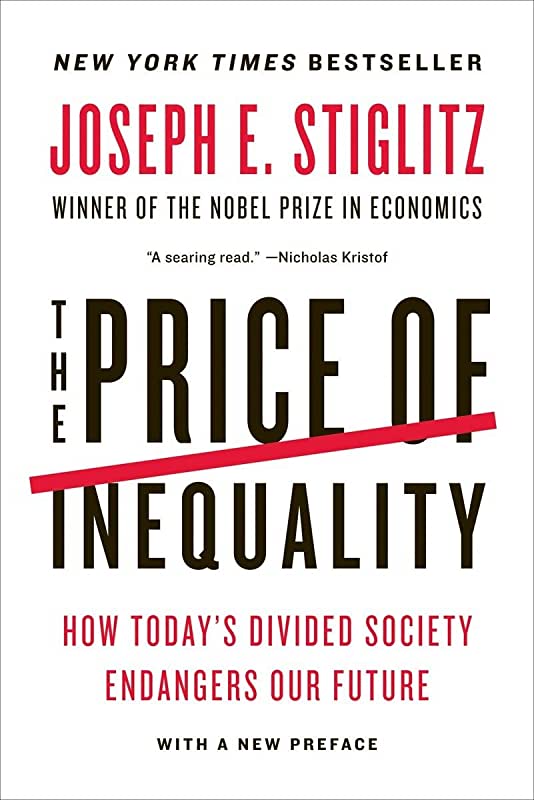
Ch 1: America’s 1% Problem
- Top 1% own >1/3 of the nation’s wealth; 1/5 of the nation’s income
- Get outsized gains in income (65% of total gain from ‘02-‘07)
- Bottom-middle grew faster in the past, not so since ~2000
- Past 30 years:
- bottom 90%: wages increased by 15%
- top 1% wages increased by 150%
- top 0.1% wages increased by 300%
- Bottom and middle have wealth in homes, not stock/ bond investments
- 37% of americans below poverty line (before government programs)
- stronger link between parental education with kids education in US than in Europe
Ch 2: Rent Seeking and the Making of an Unequal Society
- Rent seeking - getting more income by grabbing larger share of wealth, not creating it
- Taking wealth from society destroys value. i.e. monopoly restricting productivity
- This can be limited by government policy, but rent seekers lobby government
- Big in financial sector. Asymmetry of information taking advantage of the poor
- Rent seeking includes getting resource rights cheap and maximizing profits
- Big corporations lobby hard for their industries; bankers have 2.5 lobbyists per U.S. representative
Government Munificence
- Government procurement -> in drugs or defense - paying above costs for stuff
- deregulation
- Granting natural resource rights
- auctions are best. i.e. EM spectrum rights
- Tariffs - government giving unfair advantages to US businesses
- sometimes invest in R&D and increases efficiency, but also gives “old and tired” industries postponement of inevitable failure
Ch 3: Markets and Inequality
- Changes in economy. i.e. US manufacturing was a large middle-class workforce, and now its moved to China and jobs that replace them aren’t as well paying.
- Also tech reduces demand for low skill labor
- Not a given that innovation will be skill based. Can be resource based?
Globalization
- Argues that the free flow of labor is more important than free flow of capital
- low wage workers have very low bargaining power. Corporations can go elsewhere and get cheap labor
Unions
- Union membership down 10% from 1980 to 2010.
- Says labor flexibility isn’t as important as strong worker protection.
- Historically, compensation and productivity moved up together. Not anymore. Wages stagnant.
- Capital gains tax 15%. Benefits top most
- to 1% overall tax rate gone from 37% to 30% from 1979 to now
- average from 22.2% - 20.4%
Ch 4: Why it Matters
- Top 1% saves 20% of income; if 5% of that 20% is taken and given to middle income and the poor (1% of their total income), it would turn into 1.2-2% of their income being spread into the economy because of recirculation of money
- Low capital and dividend taxes in Bush era. Companies paid out high dividends because they thought it wouldn’t last
- Means smaller cash reserves and less investment in general (outside of real estate)
- Deregulation serves short term self interest and profits over long term social and economic consequences
- IMF states longer growth spells are correlated with more equal income distribution. Inequality reduces efficiency and productivity.
- Less public investment because of wealthy not wanting to sponsor it via taxes.
- Basic research is funded by gvt too.
- $3.2B spent on lobbying in 2011
- Rent seeking: waste resources for more monopoly power and preferential tax/political treatment
- scarcity of oil not priced. Oil not sustainable and therefore prices should reflect that, but they don’t.
- inequality arises because private rewards differ from social returns
- Hunger impairs productivity because you’re forced to spend limited cognitive resources on saving money and feeding your family, not on stuff to get them out of the situation.
- Happy workers are the most productive
- In experiment: Individuals in same job, 1/2 see increase wage and 1/2 see decrease wage:
- Decreases overall productivity because lower wage condition decreases productivity more than higher wage increases productivity
- Consumerism: long term relationship between GDP and wellbeing?
- maybe not. Relative income (i.e. keeping up with the Joneses) has people overextending financially.
- Higher social protections may increase willingness for high-risk, high-reward ventures
- Incentive pay imperfect. Rewards quantity over quality
- better would be to compare performance to people in similar positions or performance over time
- i.e. bankers making short sighted, risky investments in ‘08
- Most are motivated by intrinsic rewards (achievement) over extrinsic rewards (wealth)
- Also motivated to make the team proud
- Companies with shared profits did better in downturns than those without.
- Progressive taxation:
- fairness and perception of fairness increases productivity
Ch 5: A Democracy in Peril
- “Civic Virtue” is what makes people vote. If everyone who thinks like me didn’t vote, things would be determined by people I disagree with.
- If political system seems “stacked against me”, this erodes trust.
- Conversely, wealthy who see politics working for them vote more
- Social contracts and social capital hold societies together. Honesty and integrity
- Soviet Union after fall lacked this. everybody stole because “if I don’t steal this, someone else will”
- Majority of people abstain from individually beneficial, socially harmful thing if they think others do too. (and vice versa)
- “Ultimatum game” - two people. One given $100 and asked to distribute
- 2nd person can veto and everyone looses the money.
- Typically 2nd person vetoes anything less than $20 because its unfair and neither get anything
- At $30-40, 2nd person accepts because they understand the power differential
- Perceptions of unfairness affect behavior
- 61% believe economic system benefits the wealthy
- They also believe favoring the wealthy is worse than overregulation of them
- Disillusionment leads to lack of participation in politics, but also can lead to populists and extremists who attack system
- Media diversity is important to reduce disillusionment
- must be able to trust information
- Disenfranchisement - making voting harder
- Republicans think people voting who shouldn’t is a bigger problem (require IDs)
- Democrats believe the bigger problem is people who can vote, not voting
- time and $ is required to get ID for example
- Effect is poop people not voting and increasing their disillusionment so less are likely to vote again later
- Citizen’s united vs. FEC in 2010 said money was free speech in campaign finance
- Makes people’s power lower. More power to corporations who get lawmakers elected who appoint judges who make rulings like this
- Disillusionment and disenfranchisement both effective in keeping the poor and middle class from voting
- Reverse efforts include free campaign financing, reducing citizen’s united ruling’s impact
- One person, one vote not so accurate now. Median voter has higher income than median citizen. i.e. people who vote are typically richer.
- Globalization
- Financial markets (especially in poor countries) exercise outsize control over countries’ debtors (people who they’re borrowing from/ in business with)
- Financial markets provide “discipline” but can be wrong and fickle
- markets are short-sighted and seek advancement of financiers
- WTO forces financial market liberalization. Reduces ability of countries to regulate foreign banks operating there.
- Uruguay Round Trade Agreement - has gripes with IP terms that give rent seekers more money, and doesn’t allow developing countries a say in regulating IP
- There’s more globalization and as countries develop, we were a model, lecturing about balanced budgets, free markets, rent seeking, but now we’re hypocrites
Ch 6: 1984 is upon us
- Perceptions of inequality decreasing as it is actually increasing. Less interaction between low and high class?
- Beliefs and perceptions are more important in shaping collective behavior over individual behavior
- “discriminatory equilibrium” - pay some lower wages discriminatorally, their productivity goes down, which means they deserve lower wages
- Milton Freidman blames Great Depression on government failures
- Social constructs - ideas and perceptions. They don’t change fast because your opinions depend of everybody else
- Politicians use same tactics as advertisers to change public opinions/ideas/perceptions
- Battle of ideas is all framing and persuasion, not facts
- “Efficient markets” not true because of information asymmetry. People incentivized to do research and short companies as an example
- Algorithmic traders can effectively “steal” info from researchers who make a discovery because they can see people making large orders and do the same in a nanosecond
- Mortgage restructuring: instead of foreclosing, banks could have “written down” the principle and had a debt-equity conversion to give bank capital gain when the house is sold
- Would have forced banks to realize losses and required capital, which they didn’t have
- Regulation: incomes grow more in times of regulation
- Corporate welfare: tax breaks and government subsidies. Good place to start spending cuts
- no downside risk distorts markets (if taxpayers can always bail out companies)
- IMF in developing countries - financial sector has lots of influence
- “contractionary spending” - cut spending to pay back debts. May not be best
- Author emphasizing more capital controls because liberalization of markets lead to instability
- GDP per capita = output/number of people. Not a good measure of success of individuals
- Health and public sector jobs distort GDP. Their inefficiencies inflate GDP
- GNP: gross national product. Used to be used until the 1990’s when GDP took over because of globalization
- GNP: gross income of citizens
- GDP: value of goods and services produced in a country
- when no trade between countries occurs GDP = GNP
- GDP over GNP incentives foreign companies to set up and extract resources and their output contributes to countries GDP, but decreases GNP because profits go overseas
- New push for better metric than GDP these days
Ch 7: Justice for all? How Inequality is Eroding Rule of Law
- Laws incentivize people to take into account externalities (usually with stick, not carrot)
- Transaction costs: inherent cost to collect money from one group to another.
- Smoker vs. non-smoker. one has “air rights” and sells to other
- one way may be much more efficient than the other. Grave consequences
- Predatory lending: banks and insurance agencies used their political muscle to get “subsidies” (i.e. avoid regulation) of bad loans from government
- Bankruptcy laws: 2005 congress made it harder for debtors to discharge debts in bankruptcy. 25W% lifetime wage garnishment. This incentivized banks to give out worse loans because its less risk for them
- Banks pushed for this hard, but if things go opposite, they demand compensation
- Student loans not dischargeable in bankruptcy. Incentivizes quantity over quality because people who don’t finish or don’t get a good job still are required to pay back
- Gvt tried to put completion rate and student satisfaction into gvt backed loan requirements, schools fought back and largely won.
- Foreclosure: banks wrote bad loans and didn’t keep good records, so when people couldn’t pay, they couldn’t prove who. Their defense was “most do ow” without burden of proof
- Banks and those with capital can offer small deals before litigation and promise a long and hard legal battle if the victims don’t take it. This slap on the wrist is almost always worth the major profits they make with the fraud.
Ch 8: The Battle of the Budget
- After recession, house republicans didn’t want to increase debt ceiling without deficit reduction
- Early 2000’s, USA ran 2% of GDP surplus. Worried FED chair and encouraged tax cut and this started deficit growth
- War in Afghanistan and Iraq increased deficits by Trillions and will continue because of disability payed out to soldiers.
- Medicare drug benefit increased deficits too. Gvt couldn’t negotiate prices
- To reduce Deficits:
- increase capital gains taxes. The rich get dividends when taxes are low instead of company investing in for future growth.
- close loopholes in tax code. Municipal bond interest exemption. Municipalities borrow at a lower rate to get people to invest and don’t pay taxes on it. Gvt effectively subsidizing the rich. direct subsidy would be more efficient for municipalities.
- Tax on rent doesn’t cause distortion because land can’t go away. Same with natural resources and monopoly power.
- Summary:
- reduce deficits, tax top, eliminate tax loopholes the top uses, eliminate tax subsidies to corporations, increase rent tax, tax pollution, tax financial sector, charge market prices for resources.
- Balanced budget multiplier
- Keep deficit the same but increase spending and taxes, the increase in spending stimulates GDP and increases taxes.
- National debt decreases in medium term because taxes and in long term because more GDP growth and increased tax revenue
- Poor are more likely to spend 100% of their income. Unemployment for them is stimulative for GDP. Rich save a lot so unemployment for them is not.
- US can’t be compared to Greek debt crisis because the treasury can print money and buy US gvt bonds. The EU doesn’t for Greece. Not a correct comparison for welfare programs and overspending because of this.
- Corporate loan interest is tax deductible and depreciating capital assets (machines, etc.) can reduce income
- Tax code incentivizes investment
- If mortgage interest deduction and deduction for healthcare benefits were reduces, it would be an effective in crease in tax on middle class.
- mortgage interest deduction incentivizes excessive indebtedness. Government subsidizing debt, helps banks.
- raises housing prices in urban and low-income areas because supply is limited and not much incentive between owning and renting.
- can’t remove mortgage interest deduction when market is bad and people are underwater because it will further in crease expense of owning while reducing prices
- supply side Reganomics is a myth, what was profitable before tax cut is still profitable. maybe not as much though.
- Social security - reduced poverty by 17% -> all elderly people
- currently in deficit. already those at the top get less than those at bottom.
- to be sustainable, increase taxable income from $100k cap and reduce benefits and increase tax %
- Medicare - obamacare reduced medical costs?
- Paul ryan medicare voucher program?
- Austerity- reduced spending. contradictory. gct not like a household; gvt can expand spending and create jobs unlike household budget analogy
- He compares budget cutters to bloodletters in medieval times.
- Stimulus was too small and short-lived due to bad economic analysis. Thought recovery would be quicker because firms should have not laid everybody off, but they did and unemployment hit 10%
- Gvt spending when at full employment is moot. since it’d have to crowd out other spending (from private entities)
- But when unemployment is high, (GDP increase/gvt spending) i.e. multiplier is >1
- European structural reforms after recession increased competition, more privatization, gvt assistance not encouraging movement into new sectors of the economy
- improves supply side, but issue is demand in recession recovery.
Ch 9: A Macroeconomic Policy and A Central Bank by and for the 1%
Comments